


 By
Sky USDS Rate Drop What To Do: Exit Threshold Calculator
The Rate Compression: What Actually Changed

Sky USDS dropped from 10.42% to 6.01% in one week. That is a 4.41 percentage point compression on $293M in total value locked. The mechanism is straightforward. Sky Savings Rate is a governance-set variable. Sky token holders vote on adjustments through executive proposals. The rate does not respond to market forces the way lending pool rates do. It moves when governance moves it.
The drop to 6.01% puts Sky USDS below several competing stablecoin lending rates. Aave V3 USDC pays 6.47%. Morpho USDC pays between 5.8% and 7.2% depending on vault. Compound V3 USDC fluctuates between 3.2% and 6.1%. The spread between Sky and the next-best option determines whether exit gas cost is justified.
On a $200,000 position, the difference between 6.01% and 6.47% is $920 annually. Gas cost to unstake sUSDS, convert to USDC via the Peg Stability Module, and deposit into Aave on Ethereum mainnet averages $15 at 20 gwei. The exit pays for itself in six days. On a $2,000 position, the same $920 annual spread becomes $9.20. Gas cost now exceeds the annual benefit by 63%. This is the asymmetry that defines the decision.
Before you exit, you need to distinguish two scenarios. First, governance-driven permanent cuts that will persist until the next vote cycle. Second, temporary compression where the governance rate is stable but competing rates have spiked temporarily due to market volatility. Sky’s rate history shows this distinction matters.
Governance-Driven Cuts vs. Temporary Compression

Sky Savings Rate is set by governance vote. The September 2024 cut from 9% to 6.5% was a deliberate policy shift. Sky governance wanted to grow USDS supply rather than maximize per-holder yield. That cut persisted for months. The rate bottomed near 3.5% in mid-2026, then edged back up to 3.8% by September 2026, then climbed to the 6.01% current level. Each movement required an executive vote.
Compare that to competing lending rates. Aave USDC rates fluctuate daily based on utilization. When utilization spikes, rates spike. When borrowing demand drops, rates compress. Specialized USDC lending markets on Morpho have temporarily reached double-digit APYs in 2026, then dropped back to single digits within weeks. These are market-driven movements, not governance votes.
The distinction determines your exit timeline. If Sky’s 6.01% rate is the result of a governance vote that just passed, you can expect the rate to hold for 30 to 90 days minimum. Governance does not vote weekly. If competing rates spiked due to short-term borrowing demand and Sky’s governance rate has not changed, the spread may compress back within days as competing rates normalize.
To verify which scenario applies, check the Sky governance forum and recent executive votes. Look for proposals titled “Adjust Sky Savings Rate to X%” within the past 7 to 14 days. If you find one, the rate is governance-locked. If you do not, and the rate has been stable for weeks, the compression is on the competing side. That means waiting may be the correct move.
Historical pattern: holders who monitor governance closely see rate changes 30 to 60 days in advance. Proposals are discussed, debated, and voted on in public. The rate does not surprise you unless you are not watching. If you missed the governance signal and woke up to a 4.41pp drop, the decision framework below will tell you whether to exit now or wait.
Why Governance Lags Market Movements
Sky Savings Rate generally tracks the federal funds rate plus a spread reflecting real-world asset yield and crypto lending demand. But governance moves slowly. When the Fed adjusts rates, Sky governance takes weeks to respond. When crypto borrowing demand spikes and Aave rates jump, Sky’s rate does not move until governance votes. This lag creates temporary dislocations where competing rates exceed Sky’s rate by 50 to 100 basis points for days or weeks.
If you exit during a temporary dislocation and governance votes to raise Sky’s rate two weeks later, you paid gas to chase a spread that evaporated. If you stay during a permanent governance cut and competing rates remain elevated, you lose the spread every day you wait. The decision requires reading governance signals, not just comparing live rates.
Exit Threshold Calculation: Position Size vs. Gas Cost

The math is simple. Calculate annual cost of staying. Compare to annual benefit of moving. Subtract gas cost. If the net benefit exceeds zero and the payback period is acceptable, exit. If not, stay.
Annual cost of staying = Position size × (Competing rate – Sky rate). On $200,000 at 6.01%, staying costs $920 per year versus Aave USDC at 6.47%. On $50,000, the cost is $230. On $10,000, the cost is $46.
Gas cost depends on chain and congestion. On Ethereum mainnet at 20 gwei, unstaking sUSDS costs approximately $8, converting USDS to USDC via PSM costs $4, and depositing into Aave costs $3. Total: $15. At 50 gwei during congestion, the same sequence costs $37. On Base or Arbitrum, if Sky and Aave both operate there, total gas drops to under $1.
Payback period = Gas cost / Daily benefit. On $200,000 moving to Aave, daily benefit is $2.52. Payback at $15 gas is 6 days. On $10,000, daily benefit is $0.13. Payback at $15 gas is 115 days. On $2,000, daily benefit is $0.025. Payback is 600 days. The position never justifies the move.
This is the breakeven threshold. Positions under $5,000 to $10,000 rarely justify on-chain rebalancing for spreads under 100 basis points. Positions above $50,000 almost always justify it. Between $10,000 and $50,000, the decision depends on payback tolerance and rate persistence expectation.
Time Cost: Zero-Yield Window
Every migration burns 3 to 5 days at zero yield. You unstake, wait for the transaction to settle, convert, wait again, deposit into the new venue, wait for yield accrual to start. During that window you earn nothing. On $200,000 at 6.47%, 5 days of lost yield costs $177. Add that to gas cost. Total migration cost is now $192. Payback stretches from 6 days to 76 days.
If you believe the rate spread will persist for 90 days or more, the move still pays. If you believe governance will adjust Sky’s rate upward within 30 days, or competing rates will compress, the move does not pay. This is why governance monitoring is the leading indicator, not rate comparison.
Alternative Rate Comparison: Not All Venues Are Equal
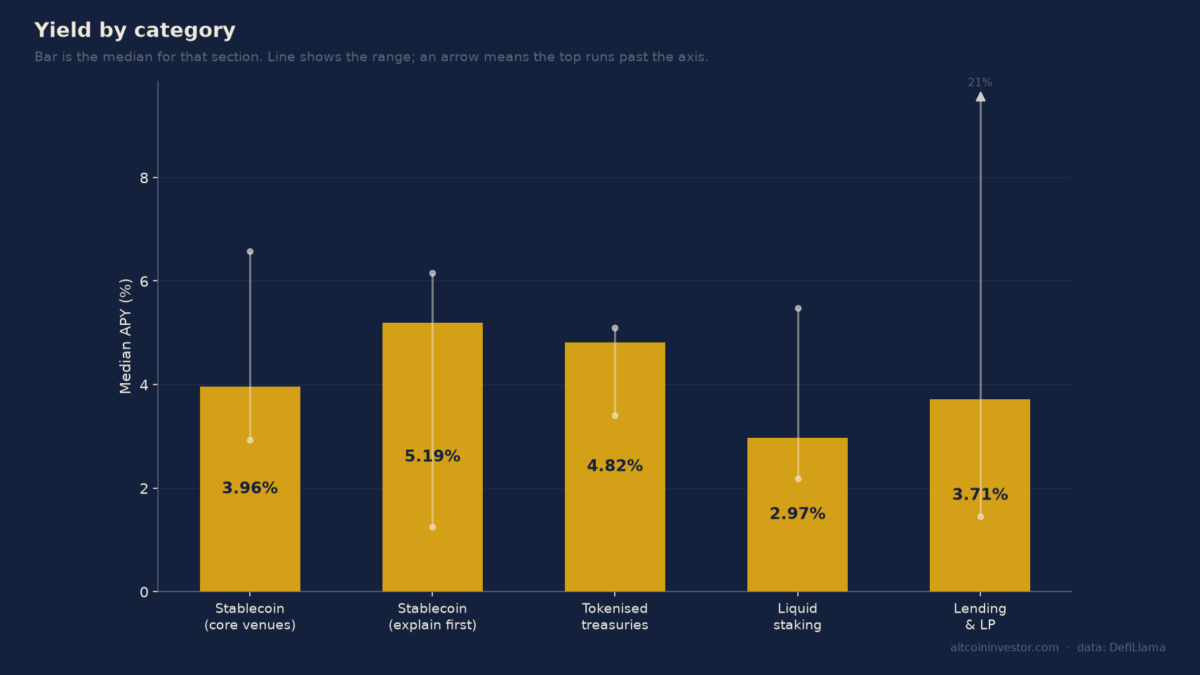
The spread between Sky USDS at 6.01% and the next-best option varies by venue. Aave V3, Morpho, Compound, and Spark all offer USDC and USDT lending. Rates fluctuate daily. As of late 2026, the interesting range is 3.5% to 9% on reputable venues. USDT usually carries the largest lending volumes and often the highest rates. The difference between platforms is far larger than the difference between coins.
Before you exit Sky, check live rates on all four venues. Use DefiLlama’s protocol page to compare. If Aave USDC pays 6.47%, Morpho USDC pays 7.1%, and Compound pays 3.2%, you are leaving 64 basis points on the table by defaulting to Aave. On $200,000, that is $1,280 annually. The migration decision should factor the best available rate, not the first one you check.
Exit immediately if all four conditions hold:
- Position size exceeds $50,000.
- Rate spread to next-best venue exceeds 50 basis points.
- Recent Sky governance vote confirms the rate is locked for 30+ days.
- Competing venue rates have been stable for 7+ days, indicating the spread is not a temporary spike.
Example: You hold $200,000 in sUSDS at 6.01%. Aave USDC has paid 6.4% to 6.5% for two weeks. Sky governance voted to lower SSR from 10.42% to 6.01% nine days ago. The next governance cycle is projected for 45 days out. The spread costs $920 per year. Gas costs $15. Payback is 6 days. You exit.
Exit within 48 hours if three conditions hold:
- Position size exceeds $100,000.
- Rate spread exceeds 100 basis points.
- Governance vote confirms rate lock.
Example: You hold $150,000 in sUSDS at 6.01%. Morpho USDC pays 7.2%. The spread is 119 basis points, costing $1,785 annually. Payback at $15 gas is 3 days. You exit immediately.
When To Wait
Wait if any of the following apply:
- Position size is under $10,000 and spread is under 100 basis points.
- Competing rates spiked in the past 48 hours and have not stabilized.
- No recent Sky governance vote explains the rate drop, suggesting the rate may adjust upward soon.
- You are on Ethereum mainnet during gas congestion above 50 gwei, and migration cost exceeds $40.
Example: You hold $8,000 in sUSDS at 6.01%. Aave USDC pays 6.5%. The spread costs $39 per year. Gas costs $15. Payback is 140 days. Unless you expect the spread to persist for six months, you wait.
Example: Morpho USDC spiked from 5.8% to 8.2% in the past 24 hours due to a short-term borrowing surge. Sky’s rate has not changed. The spike is likely temporary. You wait 7 days to see if Morpho’s rate normalizes before deciding.
Monitoring Governance: The Leading Indicator
Sky Savings Rate adjustments are visible 30 to 60 days in advance if you monitor governance. The forum at sky.money posts proposals weeks before they go to vote. Executive votes are announced on-chain and tracked by governance dashboards. If you watch governance, you do not get surprised by rate cuts.
Recent executive votes show SSR increasing to 9.5% and DSR to 8.5% when passed. Other votes show cuts from 9% to 6.5%. The pattern is clear: governance moves in discrete jumps, not continuous adjustments. Once a rate is set, it holds until the next vote. That vote is visible in advance.
If you see a proposal to lower SSR from 6.01% to 4.5% and the vote is scheduled for two weeks out, you have time to calculate the new spread, compare alternatives, and exit before the cut takes effect. If you wait until after the cut, you are reacting. If you monitor governance, you are positioning.
The failure mode: ignoring governance and relying on rate aggregators. Aggregators show you the current rate. They do not show you the rate that will take effect in 15 days. By the time the aggregator updates, the rate has already moved and you are deciding whether to chase it. Governance monitoring eliminates that lag.
On-Chain Verification
Sky’s savings module contracts are forks of the original DSR, which has operated for years with no incidents. The Peg Stability Module allows USDC holders to mint USDS at 1:1, then stake USDS into sUSDS to earn the Sky Savings Rate. The mechanism is transparent. Contract state is public. You can verify the current SSR by reading the pot contract on Etherscan.
Check the pot contract at the Sky protocol address. The SSR variable is labeled “dsr” in the contract. Divide the value by 1e27 and subtract 1 to get the annual rate. If the contract shows 1.0601e27, the rate is 6.01%. If governance voted to change the rate and the contract has not updated, the vote has not executed yet. This is the ground truth.
If the rate you see in aggregators does not match the on-chain rate, the aggregator is lagging or misconfigured. Trust the contract. Always.
Edge Cases That Change The Calculation
Three edge cases shift the decision threshold.
Layer 2 vs. Ethereum Mainnet
Gas cost on Ethereum mainnet during congestion can exceed 10x the cost on Base or Arbitrum. If you are on Ethereum and gas is 80 gwei, migration costs $60. On Base, the same migration costs $0.80. If Sky and Aave both operate on the Layer 2 you are using, the breakeven position size drops from $50,000 to $5,000. Lower gas cost justifies more frequent rebalancing.
If you are on Ethereum and considering a move, wait for low-congestion windows. Gas at 15 to 20 gwei is common during weekends and off-peak hours. A $200,000 position losing $2.52 per day can afford to wait 48 hours for cheaper gas. A $500,000 position losing $6.30 per day cannot.
Multiple Position Rebalancing
If you hold positions in three venues and all three experience rate compression simultaneously, the combined annual cost may justify a portfolio-wide rebalance even if no single position meets the threshold. Example: $30,000 in Sky USDS at 6.01%, $40,000 in Compound V3 USDC at 3.23%, and $50,000 in Fluid USDC at 5.43%. Moving all three to Morpho at 7.1% saves $1,740 annually. Gas cost for three migrations is $45. Payback is 9 days. The portfolio move justifies the cost even though the $30,000 Sky position alone would not.
Governance Risk vs. Rate Opportunity
Sky’s SSR has no contractual floor. Governance can vote to lower the rate to 1%, to 0%, or even negative if token holders decide to charge for holding USDS. There is no guarantee. The rate is entirely governance-discretionary. Competing venues like Aave and Morpho have market-driven rates that cannot fall below zero unless the protocol is exploited. The governance risk at Sky is structurally different from the market risk at Aave.
If you believe Sky governance will continue lowering rates over the next six months, exit regardless of current spread. If you believe the current rate is a floor and governance will stabilize or raise rates from here, staying is defensible. This is a governance-risk assessment, not a yield-optimization calculation.
Post-Exit Monitoring
After you exit Sky and migrate to a competing venue, set two monitoring triggers. First, if Sky’s rate rises above your new venue’s rate by more than 50 basis points and holds for 7 days, reconsider moving back. Second, if your new venue’s rate drops below Sky’s rate, recalculate the migration threshold and decide whether another move is justified.
Sky’s governance rate can rise as quickly as it falls. If the federal funds rate increases or Sky decides to prioritize yield over supply growth, SSR can jump from 6.01% back to 9% within a single vote cycle. If you exited at 6.01% and the rate jumps to 9.5% two months later, you need to decide whether to migrate back. The same calculation applies. Position size, rate spread, gas cost, payback period. The direction of the move does not change the math.
Monitor governance forums every 30 days. Skim proposal titles. Look for “Adjust SSR” or “Sky Savings Rate” in the subject line. If you see a proposal to raise rates, calculate the new spread before the vote executes. If the new rate plus governance stability justifies a return, move before the rate actually changes. You will avoid the zero-yield migration window and capture the higher rate immediately when it takes effect.
The Takeaway
A 4.41 percentage point drop from 10.42% to 6.01% on Sky USDS changes the migration decision for every position above $50,000 when competing rates exceed 6.5% and governance has locked the rate for 30+ days. Below $10,000, gas cost exceeds annual benefit unless the spread exceeds 100 basis points. Between $10,000 and $50,000, payback period determines the decision. Governance vote history is the leading indicator. Rate aggregators lag by days or weeks. If you monitor governance proposals 30 to 60 days in advance, you position before the rate moves and avoid reactive decisions. The mechanism is not market-driven. It is governance-driven. The failure mode is ignoring governance and reacting to rate changes after they occur. The verification step is reading the pot contract on-chain and comparing the dsr variable to the rate shown in aggregators. The spread, the gas cost, and the governance timeline determine whether you exit or stay.
Frequently Asked Questions
What caused Sky USDS to drop from 10.42% to 6.01%?
Sky Savings Rate is a governance-set variable. Sky token holders vote on rate adjustments through executive proposals. The 4.41 percentage point drop resulted from a governance vote, not market forces. Governance votes to adjust SSR typically occur every 30 to 90 days. The rate does not respond to borrowing demand or utilization like Aave or Compound rates do. It moves only when governance votes to change it. Check the Sky governance forum for recent executive votes titled ‘Adjust Sky Savings Rate’ to confirm the change was governance-driven.
At what position size does it make sense to exit Sky USDS for a higher rate?
Positions above $50,000 almost always justify migration when the rate spread exceeds 50 basis points and governance has locked the rate for 30+ days. Positions under $10,000 rarely justify the move unless the spread exceeds 100 basis points, because gas costs $15 on Ethereum mainnet and payback periods stretch beyond 100 days. Between $10,000 and $50,000, calculate payback period by dividing gas cost by daily benefit. If payback is under 30 days and governance has confirmed the rate lock, exit. If payback exceeds 90 days or governance may adjust the rate soon, wait.
How do I know if Sky’s rate drop is permanent or temporary?
Check Sky’s governance forum and recent executive votes. If a proposal titled ‘Adjust Sky Savings Rate to 6.01%’ passed within the past 14 days, the rate is governance-locked and will persist for 30 to 90 days minimum. If no recent vote explains the drop, the rate has not changed but competing rates may have spiked temporarily. Sky’s rate moves only when governance votes. Competing venues like Aave and Morpho have market-driven rates that fluctuate daily. If competing rates spiked in the past 48 hours and Sky’s governance rate has been stable for weeks, the spread may compress as competing rates normalize.
What is the gas cost to exit Sky USDS and move to another venue?
On Ethereum mainnet at 20 gwei, unstaking sUSDS costs approximately $8, converting USDS to USDC via the Peg Stability Module costs $4, and depositing into Aave or another venue costs $3, totaling $15. At 50 gwei during congestion, the same sequence costs $37. On Layer 2 networks like Base or Arbitrum, if Sky and your target venue both operate there, total gas drops to under $1. Wait for low-congestion windows on Ethereum to minimize cost. Gas at 15 to 20 gwei is common during weekends and off-peak hours.
Should I monitor Sky governance to predict future rate changes?
Yes. Sky Savings Rate adjustments are visible 30 to 60 days in advance if you monitor governance proposals on the Sky forum. Proposals are discussed, debated, and voted on publicly before taking effect. If you see a proposal to adjust SSR, calculate the new rate spread and decide whether to exit before the vote executes. Governance monitoring eliminates reactive decisions. Rate aggregators show the current rate but not the rate that will take effect in 15 days. By monitoring governance, you position before the rate moves and avoid zero-yield migration windows.
The Weekly Yield Report
You just calculated the exit threshold for a 4.41pp drop on $293M TVL. Governance will vote again in 30 to 60 days and the spread will shift.
Every Thursday: where crypto yield actually is – stablecoins, liquid staking and DeFi lending, with the risk named next to the rate and what changed since last week.
Free. No trade calls, no allocations, no hype. Unsubscribe in one
click.