

 By
RLUSD Stablecoin Yield Curve Pool Safe: 24-Hour Due Diligence
The Structural Opportunity

New stablecoin pools on Curve offer a specific window. The yield premium over established pairs typically lasts 30 to 90 days. Then it normalizes. During that window, deploying $250,000 captures an extra 3 to 8 percentage points if the stablecoin holds its peg. If it depegs or the issuer fails, you lose principal.
The Curve USDC-RLUSD pool appeared with 5.4% APY on $78 million TVL. RLUSD is Ripple’s dollar-backed stablecoin, issued through a NYDFS-chartered trust.
This is not a question of whether the rate is attractive. It is a question of whether the mechanism is sound.
Step 1: Verify Ripple Backing and Regulatory Status
A stablecoin yield opportunity is only as safe as the issuer’s reserve structure. Start with regulatory verification.
Regulatory Oversight
RLUSD is issued by Standard Custody & Trust Company, a NYDFS-chartered trust. This makes it the first NYDFS-regulated stablecoin. NYDFS oversight requires quarterly audits and reserve attestations.
Ripple also maintains compliance through the Dubai Financial Services Authority (DFSA). Dual regulatory oversight reduces issuer flight risk.
Check the NYDFS public registry at nydfs.gov. Confirm Standard Custody & Trust Company appears under active trust charters. If the charter is suspended or under review, exit immediately.
Reserve Composition and Attestation
RLUSD reserves consist of cash deposits, U.S. Treasuries, and cash equivalents. Each token is backed 1:1. Ripple selected BNY Mellon as primary custodian.
Ripple publishes monthly third-party attestations at ripple.com/products/stablecoin. Download the most recent attestation. Verify three items:
- Attestation date within the last 30 days
- Total reserve value equals or exceeds circulating supply
- Attestation firm is a recognized accounting entity (Big Four or equivalent)
If the attestation is more than 45 days old, delay deployment until the next report publishes.
The GENIUS Act, passed in 2025, requires monthly reserve composition reports audited by third-party accountants for issuers above certain thresholds. RLUSD falls under this mandate. If the monthly report is missing or redacted, treat it as a red flag.
Mint and Redemption Mechanics
Ripple Mint charges no mint or redeem fees. Approved institutional clients can mint and redeem through Ripple’s web portal.
This creates a price floor. If RLUSD trades below $1.00 on secondary markets, institutions can buy at discount and redeem at par. That arbitrage keeps the peg tight.
Verify that Ripple Mint is operational. Check recent mint or burn events on Etherscan. If no mints or burns have occurred in the past 14 days despite significant TVL growth, the redemption mechanism may be restricted. That is a structural depeg risk.
Step 2: Audit RLUSD On-Chain Supply

Attestations confirm reserve backing. On-chain data confirms circulating supply. The two numbers must match.
Multi-Chain Issuance
RLUSD is a native stablecoin. It is minted directly on the blockchains where it circulates: XRP Ledger, Ethereum, Base, Optimism, Ink, Unichain, and the XRPL EVM Sidechain.
Circulating supply is the sum of all on-chain issuance across these chains. DefiLlama shows approximately $1.40 billion on Ethereum and $1.12 billion on XRPL. CoinMarketCap places total circulating supply near 2.49 billion tokens.
Cross-check these figures against the most recent attestation. If on-chain supply exceeds attested reserves by more than 2%, the issuer has minted unbacked tokens. Exit.
Recent Supply Events
Large mints or burns signal shifts in institutional demand. On November 2 at 20:43 UTC, Ripple issued 110,565,832 RLUSD through its treasury. On October 30, the network saw approximately $284 million in supply withdrawn, a 28.7% reduction in circulation.
A large mint can look like growth. But until an attestation confirms proportional reserve backing, the number mostly measures token creation rather than confirmed dollar-for-dollar liquidity entering the market.
Wait for the next monthly attestation after a major mint event before deploying significant capital. The lag between mint and attestation is where unbacked issuance hides.
Supply Observability
Because RLUSD is native, mint and burn events are visible on public chains. Use Etherscan for Ethereum, XRPScan for XRP Ledger. Track the issuer wallet address. Any mint not followed by a corresponding attestation increase within 30 days is a structural red flag.
For stablecoins backed by known issuers like Ripple, this verification process takes two hours. For anonymous projects, it is not possible. That is the core distinction this checklist exploits.
Step 3: Verify Pool Deployment Date and Tracking Lag
A newly tracked pool is not always a newly deployed pool. Aggregators like DefiLlama and Curve’s own analytics may lag deployment by days or weeks.
Contract Creation Date
Open Etherscan. Search for the Curve USDC-RLUSD pool contract address. Check the contract creation transaction. Note the deployment date.
If the pool was deployed more than 14 days before it appeared on aggregator tracking, the 5.4% APY may already reflect significant yield compression. The early liquidity providers captured the premium. You are seeing the tail end.
The oldest tracked Curve metrics for RLUSD pools in available data are from March 2026. If the contract creation date predates March by weeks, the pool is not new. It is newly tracked.
TVL Growth Rate
Check TVL history on DefiLlama. The USDC-RLUSD pool showed $78.6M TVL in the week of June 4, 2026. By April 30, it was $80.2M. By April 2, it was $103M. By August 6, it dropped to $76.5M.
This is a mature pool. TVL peaked in early April and has since stabilized. The yield premium from bootstrap liquidity incentives has likely already compressed.
If you deploy now, you are not capturing launch incentives. You are capturing the sustainable rate. That is fine if the rate justifies the smart contract and depeg risk. But it changes the risk-return calculation.
Historical APY Trajectory
DeFiLlama shows the pool at 4.25% on October 21, 2026, with $48.1M TVL. At another snapshot, 6.08% with $58.7M TVL. Between September 28 and October 21, the pool slipped from approximately 4.61% to lower levels.
The 5.4% figure in your checklist likely reflects a point in that range. If current live rates are below 5.4%, the opportunity has already compressed.
Check live data on Curve before deploying. If the rate has dropped 1 percentage point or more since your initial research, recalculate the opportunity cost. An extra 4.2% on $250,000 is $10,500 annual. An extra 5.4% is $13,500. The difference is $3,000. If the rate has compressed, so has the edge.
Step 4: Compare Against Existing USDC Pair Rates
A 5.4% APY on a stablecoin-to-stablecoin pair is not inherently suspicious. But it demands comparison to structurally similar pools.
Curve Stablecoin Pool Benchmark
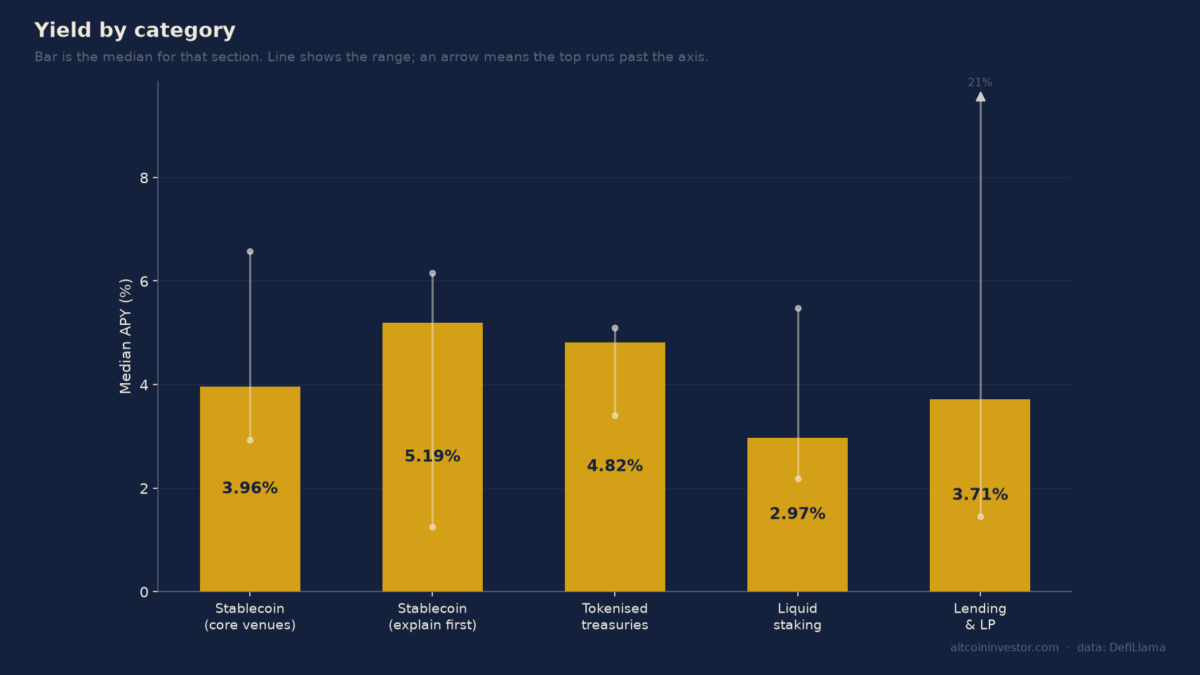
As of October 2026, Curve stablecoin pools over $5M showed a median base APY of 0.6% and median aggregate APY of 3.5%. USDC-RLUSD at 5.4% sits in the upper tier.
Other large stablecoin pairs:
- DOLA-sUSDe: $61.0M TVL, 4.20% APY
- USDC-RLUSD: $48.1M TVL, 4.25% APY
- USDT-crvUSD: $46.4M TVL, 3.18% APY
- FRAX-USDe: $34.0M TVL, 2.79% APY
- PYUSD-USDC: $14.9M TVL, 3.46% APY
USDC-RLUSD’s rate is not an outlier. It is within the range of other large stablecoin pairs with newer or less liquid assets. The premium reflects RLUSD’s relative youth compared to USDC.
Rate Compression Timeline
New stablecoin pools typically offer elevated rates for 30 to 90 days. After that window, yield compresses toward the median. If RLUSD launched in late 2025 or early 2026, the pool is now beyond the bootstrap phase.
The rate you see today is likely the sustainable rate, not the launch premium.
Risk-Adjusted Comparison
Compare USDC-RLUSD at 5.4% against other stablecoin income strategies. Aave USDC averaged 2.4% to 3.8% in 2026. Curve pools ranged from 0% to 6%.
An extra 1.5 to 3 percentage points above Aave justifies additional risk if the stablecoin is backed by a regulated issuer with monthly attestations. It does not justify that risk if the issuer is anonymous or reserves are unaudited.
RLUSD meets the issuer quality threshold. The rate premium is within the expected range for a newer stablecoin with proven regulatory backing.
Step 5: Distinguish Bootstrap Incentives from Sustainable Yield
The yield on a Curve pool decomposes into three sources: trading fees, CRV emissions, and external incentives.
Trading Fee Component
Curve charges a trading fee on each swap. This fee is distributed to liquidity providers. For stablecoin pools, the fee tier is typically 0.01% to 0.04%.
Check the pool’s 7-day trading volume on Curve. Divide weekly fees by TVL. Annualize. For a $78M pool, if weekly fees are $5,000, that is approximately 0.33% APY from fees alone.
Trading fees are sustainable. They scale with volume. They do not expire.
CRV Emission Component
Curve distributes CRV tokens to liquidity providers based on gauge weights. These emissions are set by governance vote and change every two weeks.
CRV emissions are semi-sustainable. They depend on ongoing governance support. A pool can lose its gauge allocation if liquidity providers or veCRV holders shift votes elsewhere.
Check the current gauge weight for USDC-RLUSD on Curve’s governance dashboard. If the gauge weight has declined by more than 20% over the past month, the emission component is at risk.
External Incentive Component
Some protocols bribe liquidity providers to attract TVL. These bribes are paid in the protocol’s native token or in stablecoins.
External incentives are temporary. They are the first component to disappear when a protocol’s treasury runs low or when the team decides the pool no longer needs bootstrapping.
If USDC-RLUSD’s 5.4% APY includes significant external incentives, the rate will compress when those incentives end. Check Votium or other bribe markets to see if RLUSD is being actively incentivized.
If no external incentives are active, the 5.4% is likely trading fees plus CRV emissions. That is a more durable rate structure.
Depeg and Impermanent Loss Risk
Impermanent loss in a stablecoin-to-stablecoin pool is negligible unless one asset depegs. If RLUSD drops to $0.95, you will be holding more RLUSD and less USDC than you deposited. When you withdraw, you realize that loss.
The yield premium exists because the market prices in a small probability of depeg. A 1.5 percentage point premium over Aave USDC implies the market assigns roughly a 1.5% annual probability of a 100% loss event, or a higher probability of a smaller depeg.
RLUSD has had zero depeg events since launch. The peg has remained within 0.1% of $1.00 on all major exchanges. This is a strong signal. But it does not guarantee future peg stability.
Terra UST also held its peg for months before collapsing. The difference is structural. Terra relied on an algorithmic feedback loop. RLUSD relies on dollar reserves held by a regulated custodian. Those are different failure modes.
Step 6: Evaluate Smart Contract and Composability Risk
Curve was exploited in July 2023. The attacker drained approximately $70 million from several pools. Curve recovered user funds via a white-hat bounty, but the event demonstrates that even mature protocols carry smart contract risk.
Audit History
Curve’s core contracts have been audited by Trail of Bits, Quantstamp, and MixBytes. The USDC-RLUSD pool uses Curve’s StableSwap implementation, which is the most battle-tested pool type in DeFi.
Check whether the pool uses a custom implementation or the standard StableSwap factory. Custom implementations carry additional risk. Standard factory pools inherit the security profile of the core contract.
If the pool contract address is a factory-deployed instance, the smart contract risk is limited to Curve’s core StableSwap logic. If it is a custom deployment, request an independent audit report before deploying significant capital.
Composability Risk
If you use leverage or stack additional yield strategies on top of Curve LP tokens, you introduce composability risk. A failure in one protocol can cascade to others.
For example, if you deposit Curve LP tokens into Convex to earn boosted CRV rewards, you are now exposed to Convex’s smart contract risk in addition to Curve’s risk.
Limit composability layers to two. Curve plus Convex is acceptable. Curve plus Convex plus a lending protocol is not.
Step 7: Run the Stress Test
Every yield strategy has a specific failure mode. Name it before you deploy.
Scenario 1: RLUSD Depeg
If RLUSD drops to $0.90, your LP position converts to approximately 55% RLUSD and 45% USDC. When you withdraw, you realize a 5.5% loss on your initial capital.
For this to be profitable, the yield must exceed the depeg loss. At 5.4% APY, you break even after one year if RLUSD recovers to peg. If it does not recover, you lose principal.
The probability of a 10% depeg within one year is the key variable. If you assign that probability at 5%, the expected loss is 0.55%. The net expected return is 4.85%. That is acceptable.
If you assign that probability at 20%, the expected loss is 1.1%. The net expected return is 4.3%. Still acceptable, but the margin is narrower.
Scenario 2: Curve Smart Contract Exploit
If Curve is exploited again, the outcome depends on whether the exploit is contained and whether a recovery mechanism exists.
In 2023, Curve recovered user funds. But that was not guaranteed. The attacker could have refused the bounty. The next exploit may not be recoverable.
Assign a 2% annual probability to a 100% loss event from smart contract exploit. The expected loss is 2%. The net expected return is 3.4%.
If that is unacceptable, do not deploy.
Scenario 3: RLUSD Issuer Failure
If Standard Custody & Trust Company fails, RLUSD becomes unbacked. The token drops to zero.
NYDFS oversight and BNY Mellon custodianship significantly reduce this risk. A NYDFS-chartered trust failing without regulatory intervention is rare. But it is not impossible.
Assign a 0.5% annual probability. The expected loss is 0.5%. The net expected return is 4.9%.
Combined Stress Test
Add the expected losses: 0.55% (depeg) + 2% (exploit) + 0.5% (issuer failure) = 3.05%. Subtract from the 5.4% yield. Net expected return: 2.35%.
If that is higher than your opportunity cost, deploy. If not, stay in Aave or another lower-risk strategy.
What to Do Next
If RLUSD passes the checklist, staged deployment is optimal. Deploy 25% of intended capital immediately. Monitor for 30 days. If the peg holds and no red flags emerge, deploy the remaining 75%.
This approach captures 75% of the yield while limiting exposure to early failure modes.
Set up on-chain alerts for the following events:
- RLUSD price drops below $0.98 on any major exchange
- Mint or burn events from the issuer wallet that exceed 10% of circulating supply
- Attestation publication delayed by more than 45 days
- Curve gauge weight for USDC-RLUSD drops by more than 30%
If any of these conditions trigger, exit within 24 hours. Do not wait for confirmation. The market will front-run you.
The Takeaway
The Curve USDC-RLUSD pool at 5.4% is not a launch-phase bootstrap opportunity. It is a mature pool with a sustainable rate structure backed by a NYDFS-regulated issuer. The yield premium over Aave reflects smart contract risk and residual depeg risk, not structural instability.
You have just verified issuer backing, on-chain supply, pool maturity, and compared the rate against peer pools. Those numbers will shift. RLUSD’s circulating supply will grow. The Curve gauge weight will change. The next monthly attestation may show reserve composition changes. Monitor those signals. The mechanism is sound until one of them breaks.
Frequently Asked Questions
Is RLUSD safe compared to USDC or USDT?
RLUSD is issued by a NYDFS-chartered trust with BNY Mellon as custodian, making it structurally similar to USDC in reserve backing and regulatory oversight. It has maintained its peg since launch with zero depeg events. The main difference is maturity: USDC has years of peg history; RLUSD has months. If you trust NYDFS oversight and dollar reserves held by regulated custodians, RLUSD carries similar structural risk to USDC. If you require multi-year peg stability as proof, wait another six months before deploying significant capital.
Why does USDC-RLUSD pay more than other stablecoin pairs?
The yield premium reflects RLUSD’s relative youth and lower liquidity compared to USDC. New stablecoin pools typically offer 1 to 3 percentage points above established pairs to attract liquidity. As RLUSD matures and TVL grows, the rate will compress toward the median. Current rates also include CRV emissions allocated by governance. If the Curve gauge weight drops, so does the yield. The premium is not a red flag if the issuer is regulated and reserves are attested. It is a market-clearing rate for accepting slightly higher depeg risk and lower secondary market liquidity.
What happens if RLUSD depegs while I am providing liquidity?
If RLUSD drops to $0.95, the Curve pool automatically rebalances, selling USDC and buying RLUSD to maintain the 50-50 ratio. You end up holding more RLUSD and less USDC than you deposited. When you withdraw, you realize that loss. The exact loss depends on how far and how long RLUSD depegs. A 5% depeg for one day costs roughly 2.5% of your position. A permanent depeg to zero costs 50%. The yield compensates for the probability-weighted expected loss. If the depeg is temporary and RLUSD recovers to peg, your loss is minimal. If it does not recover, your principal is impaired.
How do I verify that RLUSD reserves are actually backed?
Download the most recent monthly attestation from Ripple’s transparency page at ripple.com. Check three items: attestation date within 30 days, total reserve value equals or exceeds circulating supply, and attestation firm is a recognized accounting entity. Then cross-check circulating supply on DefiLlama and CoinMarketCap against the attested reserve figure. If on-chain supply exceeds attested reserves by more than 2%, the issuer has minted unbacked tokens. Also verify that recent large mint events are followed by a corresponding reserve increase in the next attestation. A mint without a matching reserve increase is a structural red flag.
Should I use Convex to boost my Curve USDC-RLUSD yield?
Convex boosts CRV emissions by locking CRV on your behalf and sharing the boosted rewards. This typically adds 0.5 to 2 percentage points to your APY. The trade-off is composability risk: you are now exposed to both Curve’s smart contract risk and Convex’s smart contract risk. If either protocol is exploited, you can lose principal. Limit composability layers to two. Curve plus Convex is acceptable. Curve plus Convex plus a lending protocol is not. If the extra 1 percentage point justifies the additional smart contract risk, deploy. If not, stay with native Curve LP tokens.
The Weekly Yield Report
You have just verified issuer backing, on-chain supply, pool maturity, and compared the rate against peer pools. Those numbers will shift as RLUSD’s supply grows and Curve’s gauge weights change.
Every Thursday: where crypto yield actually is – stablecoins, liquid staking and DeFi lending, with the risk named next to the rate and what changed since last week.
Free. No trade calls, no allocations, no hype. Unsubscribe in one
click.