


 By
By How to Claim Crypto Losses on Taxes: Capital Loss Rules
What You Will Accomplish
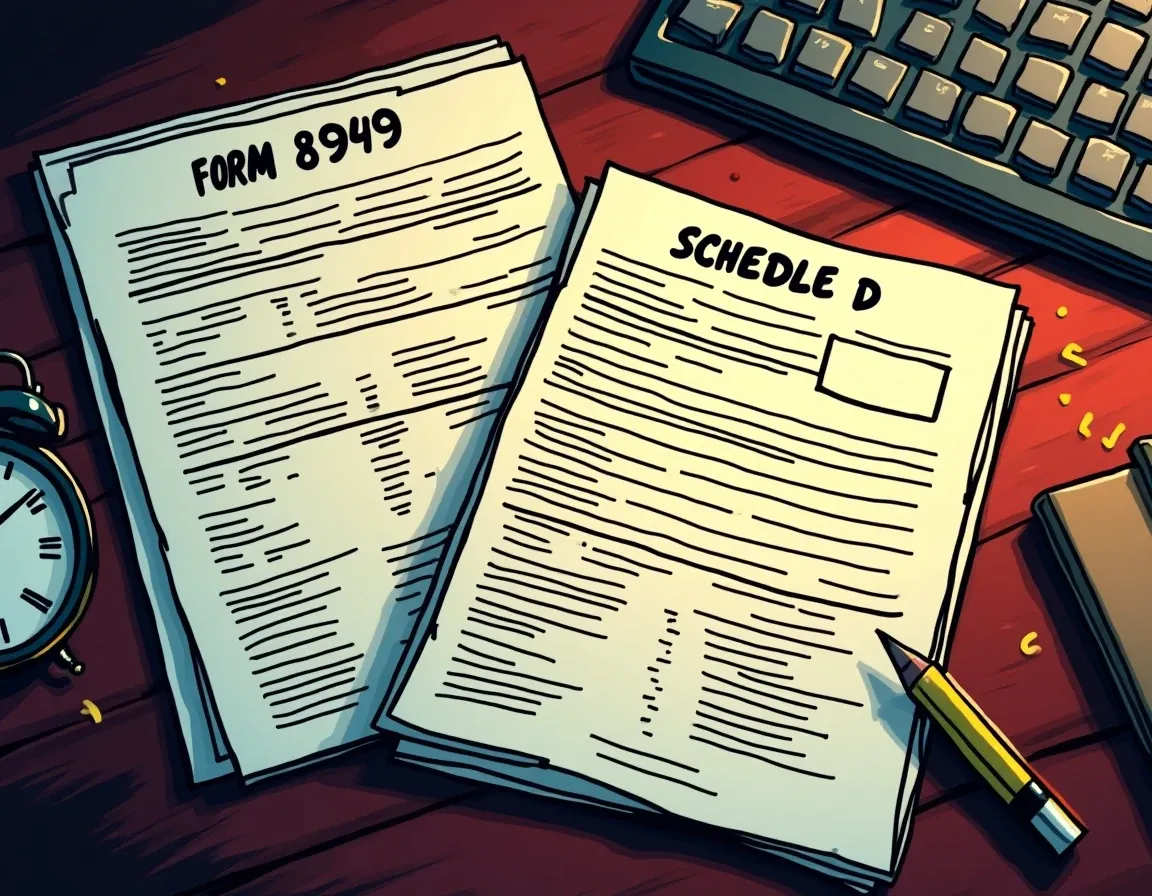
You will report realized cryptocurrency capital losses to the IRS using Form 8949 and Schedule D. You will understand the $3,000 annual deduction limit against ordinary income, how to carry forward unused losses to future tax years, and the documentation the IRS requires to support your claim. This process reduces your tax liability through loss harvesting and carryforward mechanics, particularly when managing multi-year yield positions.
Prerequisites: you must have realized a loss by disposing of cryptocurrency at a price lower than your cost basis. Unrealized losses, no matter how large, do not qualify. You need transaction records showing acquisition date, acquisition cost, disposal date, and disposal proceeds for every taxable event.
In Argentina, capital controls forced millions to hold savings in USDT rather than pesos. Those who allocated a portion to Bitcoin during the 2021 peak and later sold at a loss face the same reporting challenge you do. The mechanism is identical whether you realized a $2,000 loss on a BTC trade in San Francisco or a $2,000 loss unwinding a yield position in Buenos Aires. The IRS requires Form 8949 either way.
How Form 8949 and Schedule D Work Together
Form 8949 is the line-by-line transaction detail. Schedule D is the aggregation and netting layer. You cannot skip Form 8949 and go straight to Schedule D. The two-document flow is mandatory.
Form 8949 has two parts. Part I reports short-term transactions, meaning you held the cryptocurrency for one year or less before disposal. Part II reports long-term transactions, held for more than one year. Each transaction gets its own line: description of property (for example, “0.5 BTC”), date acquired, date sold, proceeds, cost basis, and the resulting gain or loss.
The IRS added transaction codes to Form 8949 to indicate the source of your data. If your exchange sent you a Form 1099-DA reporting gross proceeds and cost basis, and those numbers match your records, you use Box A for short-term or Box D for long-term. If the 1099-DA reported proceeds but not basis, you use Box B or Box E. If nothing was reported to the IRS at all, you use Box C or Box F.
After completing Form 8949, you transfer the totals to Schedule D. Schedule D performs the netting. Short-term losses offset short-term gains first. Long-term losses offset long-term gains first. Only after those internal offsets does the IRS allow you to net short-term results against long-term results. The final number on Schedule D, your net capital gain or loss, flows to Form 1040 line 7.
This two-layer structure matters because it determines what survives into carryforward. A taxpayer with $50,000 in long-term losses and $45,000 in long-term gains nets to a $5,000 long-term loss. That $5,000 is subject to the $3,000 annual limit against ordinary income, leaving $2,000 to carry forward, not $47,000.
The $3,000 Annual Deduction Limit and How It Works

After netting all capital gains and losses, the IRS allows you to deduct up to $3,000 of net capital loss against ordinary income per year. If you are married filing separately, the limit is $1,500. This limit has remained unchanged for years and applies to 2025, 2026, and beyond until Congress changes it.
The limit applies to your net loss, not your gross losses. If you have $10,000 in short-term losses and $5,000 in short-term gains, your net short-term loss is $5,000. You deduct $3,000 against ordinary income this year and carry forward the remaining $2,000.
There is no limit on using capital losses to offset capital gains. If you are carrying forward $200,000 in losses from prior years and you realize $200,000 in gains this year, the entire carryforward absorbs the gains. The $3,000 limit only applies to the portion you deduct against wages, interest, or other ordinary income.
This is the primary income mechanism: a large realized loss from a yield position unwound in Year 1 can offset staking rewards, LP fees, and other ordinary income up to $3,000 per year, then offset any capital gains you realize in future years without limit. The carryforward becomes a multi-year tax asset.
Carryforward Mechanics and Character Preservation
Unused capital losses carry forward indefinitely under IRC sections 1211 and 1212. There is no expiration. A loss realized in 2022 can offset a gain in 2035 if you have not used it yet.
Carryforwards preserve their character as short-term or long-term. A short-term loss from 2023 remains a short-term loss when carried to 2024, 2025, and beyond. This matters because long-term losses offset long-term gains first, and short-term losses offset short-term gains first, before any cross-netting occurs.
The IRS treats the $3,000 deduction as a short-term capital gain for purposes of computing what survives into the next year. This means the $3,000 comes out of your short-term loss bucket first, even if you also have long-term losses. A taxpayer with $5,000 in short-term losses and $10,000 in long-term losses will deduct $3,000 against ordinary income (absorbed from the short-term bucket), carry forward $2,000 short-term and $10,000 long-term.
Most taxpayers and many CPAs miss this ordering rule. The result is that long-term losses tend to survive into carryforward at higher rates than short-term losses. If you are managing a multi-year DeFi position with yield income taxed as ordinary and a later exit generating capital losses, tracking the character of each loss component is essential.
Record your carryforward on your Schedule D each year. Line 6 on Schedule D (short-term) and line 14 (long-term) ask for prior-year carryforward. The IRS does not automatically track this for you. If you forget to claim a carryforward, it does not disappear, but you will need to amend prior returns to recover it.
Realized vs. Unrealized Losses and Common Mistakes
Only realized losses are deductible. A realized loss occurs when you dispose of cryptocurrency through a sale, trade, or exchange at a price lower than your cost basis. Holding Bitcoin that has declined in value does not create a realized loss. Your wallet balance and unrealized loss do not matter to the IRS until you execute a taxable disposition.
This creates the core of tax-loss harvesting: you sell the asset to realize the loss, claim the deduction, and if you still want exposure to that asset, you buy it back. In traditional securities markets, the wash sale rule under IRC section 1091 disallows the loss if you repurchase the same or substantially identical security within 30 days before or after the sale.
As of 2026, cryptocurrency is classified as property, not a security. Section 1091 does not apply to direct sales of Bitcoin, Ethereum, or other digital assets. You can sell Bitcoin at a loss, buy it back the same day, and still claim the capital loss on Form 8949. This is a significant advantage over stock traders, who must wait 31 days to avoid the wash sale disallowance.
This treatment is fragile. Congress has considered extending the wash sale rule to digital assets in multiple legislative drafts. The IRS has not issued guidance explicitly blessing same-day loss harvesting in crypto, though the statute does not currently prohibit it. If you harvest losses aggressively, document the distinction between direct crypto holdings and crypto-linked securities like futures ETFs or company stocks, which do fall under section 1091.
The most common mistake is forgetting to track cost basis across wallets and exchanges. When you transfer Bitcoin from Coinbase to a hardware wallet, that is not a taxable event, but your cost basis travels with the asset. If you later sell from the hardware wallet, the cost basis is still the original acquisition price on Coinbase, not the market value at the time of transfer. Failing to track this creates two failure modes: claiming a loss that does not exist, or overpaying tax because you forgot your actual basis was higher.
Yield Positions, Staking Rewards, and Two-Bucket Scenarios
Yield farming and staking create a two-bucket tax scenario that most single-event trading guides ignore. Staking rewards are taxable as ordinary income at the moment you receive them, per Revenue Ruling 2023-14. Lending interest accrues with every block and is also ordinary income. LP fees in Uniswap v2 and v3 pools follow different accrual rules, but the result is the same: you pay income tax on the reward when you receive dominion and control.
If you stake ETH in 2024 and earn $8,000 in staking rewards, you report $8,000 of ordinary income on your 2024 return. That $8,000 becomes the cost basis in the newly received ETH. If the market crashes in 2025 and you sell the staked ETH at a $12,000 capital loss, you report the $12,000 loss on Form 8949 in 2025. The $8,000 of ordinary income you already paid tax on in 2024 does not reduce the 2025 loss, but the $8,000 is now part of your cost basis, which limits the size of the loss.
This two-bucket structure is why multi-year yield positions require careful documentation. The yield you earned in Year 1 increased your cost basis. The capital loss you realized in Year 2 reflects the decline from that elevated basis. If you forget to add the staking rewards to basis, you will overstate the capital loss and trigger an audit if the IRS cross-references your 1099-DA proceeds against incomplete basis records.
Impermanent loss in liquidity pools is a separate edge case. The IRS has not issued definitive guidance. Depositing into a Uniswap pool typically produces LP tokens and is treated as a taxable swap of the underlying assets for the LP token. Withdrawing reverses the transaction. If the value of the assets you withdraw is less than the value you deposited due to price divergence, some CPAs argue this is a realized capital loss. Others argue impermanent loss is not realized until you exit the pool and sell the underlying tokens. Conservative practitioners wait until final disposition. Aggressive practitioners claim the loss at withdrawal. The IRS has not ruled, so if you take an aggressive position, document the methodology and be prepared to defend it.
Documentation Requirements and IRS Scrutiny Under Form 1099-DA
The IRS introduced Form 1099-DA for digital asset transactions. Brokers must report gross proceeds for sales occurring on or after January 1, 2025. Cost basis reporting begins for covered digital assets acquired in a broker account on or after January 1, 2026. This means the IRS increasingly sees your sale proceeds directly from the exchange. Your basis records need to hold up under cross-reference.
For every transaction on Form 8949, you need the date acquired, date sold, proceeds, cost basis, and resulting gain or loss. If you used multiple exchanges, moved assets between wallets, or participated in DeFi protocols, reconstructing this data is the hardest part of the process. Most exchanges provide CSV exports, but they rarely calculate cost basis correctly, especially if you transferred assets in or out.
Acceptable documentation includes exchange transaction histories, blockchain explorer records showing wallet transfers, contemporaneous notes recording acquisition prices, and third-party tax software reports that reconcile wallet and exchange activity. The IRS does not require a specific format, but the burden of proof is on you. If your reported basis is higher than what the exchange reported, or if you claim a loss on an asset the IRS has no record of you purchasing, expect a CP2000 notice asking for substantiation.
If your 1099-DA shows proceeds but not basis, you must manually enter basis and use the correct box code on Form 8949. If you received no 1099-DA at all, for example because the transaction occurred on a non-U.S. exchange or a self-custodied wallet, you still report it using Box C or Box F. Failing to report a transaction because you did not receive a 1099-DA is not a defense. The taxable event still occurred.
For users in Turkey routing stablecoin corridors or in Nigeria using P2P exchanges, the absence of a U.S.-issued 1099-DA does not eliminate the reporting requirement if you are a U.S. taxpayer. The IRS expects you to report worldwide income and gains. If you realized a capital loss on a non-U.S. platform, document the transaction the same way you would a Coinbase trade and report it on Form 8949 with the appropriate box code.
Step-by-Step Filing Process
First, gather all transaction records. Export CSVs from every exchange you used. Download wallet transaction histories from blockchain explorers if you used self-custody. If you participated in DeFi protocols, retrieve on-chain records of deposits, withdrawals, swaps, and LP position entries and exits. Organize by short-term (held one year or less) and long-term (more than one year).
Second, calculate cost basis for each transaction. If you bought 1 BTC for $30,000 and sold it for $20,000, your cost basis is $30,000, proceeds are $20,000, and your loss is $10,000. If you received staking rewards worth $5,000 at the time of receipt, your cost basis in those rewards is $5,000. If you later sold them for $3,000, the loss is $2,000. Match every sale to an acquisition using FIFO, specific identification, or whatever method you chose, but use the same method consistently across all assets.
Third, complete Form 8949 Part I for short-term transactions and Part II for long-term transactions. Enter each transaction on a separate line or attach a statement with the same information if you have hundreds of trades. Use the correct box code based on whether you received a 1099-DA and whether it included basis. Sum the gains and losses in each part and transfer the totals to Schedule D.
Fourth, complete Schedule D. Enter short-term totals from Form 8949 Part I into Schedule D Part I. Enter long-term totals from Form 8949 Part II into Schedule D Part II. If you have capital loss carryforward from prior years, enter it on line 6 (short-term) or line 14 (long-term). The form will net everything and calculate your final capital gain or loss.
Fifth, apply the $3,000 deduction limit. If your net capital loss exceeds $3,000, Schedule D will automatically limit the deduction to $3,000 (or $1,500 if married filing separately) and show the amount to carry forward to next year. Record the carryforward amount in your personal tax files. The IRS does not store it for you. You will need it next year.
Sixth, attach Form 8949 and Schedule D to your Form 1040 and file. If you are using tax software, it will generate the forms automatically once you enter the transactions. If you are filing by hand, double-check every line and every transferred total. Errors in the netting process or forgetting to claim a carryforward are the two most common mistakes.
What Happens If You Forget or Make a Mistake
If you forget to claim a capital loss in the year you realized it, you can file an amended return using Form 1040-X. The statute of limitations is generally three years from the date you filed the original return. If you realized a loss in 2024 and filed in April 2025, you have until April 2028 to amend and claim the loss.
If you claim a loss and later discover your cost basis was wrong, you should amend. Overstating a loss is more dangerous than understating it because the IRS treats it as underpayment of tax, which can trigger penalties and interest. Understating a loss just means you overpaid, and you can amend to get a refund.
If the IRS sends you a CP2000 notice because your reported basis does not match the 1099-DA they received, respond with documentation. Provide the transaction history showing your actual acquisition date and cost. If you transferred the asset from another wallet or exchange, show the blockchain record and the original purchase. The IRS will adjust your account if the documentation supports your position.
If you are carrying forward losses and fail to claim them in a given year, the carryforward does not expire. You can claim it in a future year, but you cannot skip years selectively. If you had a $10,000 carryforward in 2024 and forgot to claim it, you must amend 2024 to claim the $3,000 deduction that year before you can use the remaining $7,000 in 2025.
What to Do Next
Organize your records now, before the next tax year closes. Export transaction histories from every exchange. Download wallet records from blockchain explorers. If you use DeFi protocols, retrieve on-chain data showing deposits, withdrawals, and swaps. If you have not been tracking cost basis in real time, start now. Use a spreadsheet or third-party tax software to reconcile wallet transfers and calculate basis for every holding.
If you realized significant losses in a prior year and did not claim them, calculate whether amending is worth the effort. If the carryforward is large enough to offset future gains or provide the $3,000 annual deduction for multiple years, file Form 1040-X.
If you are managing multi-year yield positions, track the character of each loss component. Know which losses are short-term and which are long-term. Know how much carryforward you have and in which bucket. This matters when you realize future gains because the netting order determines how much of the carryforward you consume.
If you earned staking rewards or LP fees in prior years, add those amounts to the cost basis of the tokens you received. Do not double-tax yourself by forgetting that the ordinary income you already reported created basis in the new tokens.
You now know how to report crypto capital losses, how the $3,000 limit works, how to preserve and claim carryforwards, and what documentation the IRS requires. The forms are not complicated, but the multi-year netting and character preservation mechanics trip up most taxpayers. If you have a large carryforward or complex yield positions, verify your methodology with a CPA who understands digital asset taxation before you file.
The Takeaway
Form 8949 reports every realized crypto loss as a line item. Schedule D nets short-term against short-term, long-term against long-term, then applies the $3,000 annual deduction limit. Unused losses carry forward indefinitely and preserve their character. The $3,000 deduction comes out of the short-term bucket first, so long-term losses survive into carryforward at higher rates. Staking rewards and LP fees create ordinary income in Year 1 and increase cost basis, which affects the capital loss calculation in Year 2 when you exit the position. Crypto avoids the wash sale rule today, but that advantage is policy-dependent. Document everything, because Form 1099-DA means the IRS sees your proceeds and will cross-reference your basis. Multi-year yield positions require tracking the character and timing of every component, or you will either overpay or trigger an audit. The carryforward is a multi-year tax asset, not a one-time event, and managing it correctly can offset significant future income.
Frequently Asked Questions
Can I deduct crypto losses if I didn’t sell, just held a position that declined?
No. Only realized losses are deductible. A realized loss occurs when you dispose of cryptocurrency through a sale, trade, or exchange at a price lower than your cost basis. Holding an asset that has declined in value does not create a tax deduction. You must execute a taxable transaction to realize the loss and report it on Form 8949.
Does the wash sale rule apply to Bitcoin and Ethereum losses?
Not under current IRS rules as of 2026. IRC section 1091 disallows losses only for stock or securities. The IRS classifies cryptocurrency as property, not a security, so you can sell Bitcoin at a loss and buy it back the same day while still claiming the capital loss. This treatment could change if Congress extends the wash sale rule to digital assets.
How much of my crypto losses can I deduct each year?
Capital losses first offset capital gains without limit. After netting all gains and losses, you can deduct up to $3,000 of net capital loss against ordinary income per year, or $1,500 if married filing separately. Any unused loss carries forward indefinitely to future tax years and retains its character as short-term or long-term.
What happens to my staking rewards when I claim a capital loss on the position?
Staking rewards are taxable as ordinary income when you receive them, per Revenue Ruling 2023-14. That income amount becomes the cost basis in the newly received tokens. If you later sell at a loss, the capital loss is calculated from that elevated basis. The ordinary income you already paid tax on does not reduce the capital loss, but it does increase your cost basis, which limits the size of the loss.
Do I need to report crypto losses if I didn’t receive a 1099-DA from the exchange?
Yes. Every realized capital loss must be reported on Form 8949, regardless of whether you received a 1099-DA. If no form was issued, use box code C for short-term or F for long-term transactions. The absence of a 1099-DA does not eliminate the reporting requirement. You are responsible for reporting all taxable events, including those on non-U.S. exchanges or in self-custodied wallets.
Tool mentioned above
Koinly
Koinly imports from 800+ exchanges and wallets and handles the DeFi cases most tools get wrong – rebasing tokens, LP positions, staking rewards.
We may earn a commission if you sign up through this link, at no cost to you. It does not change what gets recommended.
The Weekly Yield Report
You have just reviewed Form 8949 reporting, the $3,000 limit, and carryforward character preservation. Those rules stay stable, but 1099-DA enforcement and wash sale legislation will not.
Every Thursday: where crypto yield actually is – stablecoins, liquid staking and DeFi lending, with the risk named next to the rate and what changed since last week.
Free. No trade calls, no allocations, no hype. Unsubscribe in one
click.