


 By
By Complete Guide to Automated Trading in 2026
An auto trading bot is a computer program that executes buy and sell orders in financial markets based on predefined rules and strategies. Whether you’re eyeing crypto markets that never sleep or want to capture opportunities in stocks and forex while you focus on other work, automated trading has become an essential tool for modern traders.
Auto trading bots account for an estimated 70% to 80% of all U.S. stock trading volume, transforming how markets operate. This guide covers everything you need to know about deploying trading bots effectively in 2026.
Key Takeaways
- Auto trading bots execute predefined trading strategies across multiple asset classes 24/7, removing emotional biases like fear-driven panic selling or greed-induced overtrading
- Automated trading bots enable participation in always-on crypto markets and can execute trades in milliseconds, far faster than human traders
- AI trading bots rely on historical data, machine learning models, and pattern recognition, yet they still require human oversight, risk limits, and ongoing monitoring
- Traders can choose between ready-made crypto bots, DCA bots, and grid bots, or build custom systems using APIs and Python
- Proper backtesting on historical market data, paper trading, and gradual scaling are essential before deploying real capital in live markets
What Is an Auto Trading Bot?
An auto trading bot is software that automatically sends buy and sell orders to an exchange or broker based on predefined rules and market conditions. These automated trading systems connect to trading platforms via API keys, monitoring real time data and executing trades based on your configured strategy logic.
Algorithmic trading bots automate execution based on predefined rules, allowing traders to react to market conditions faster than manual trading. Adoption exploded post-2010 with retail access via platforms like MetaTrader for forex, and the 2017 crypto boom brought automated trading to exchanges like Binance and Coinbase.
Trading bots are designed to automate execution based on predefined rules, but they do not understand market context or intent unless explicitly programmed.
The difference between basic rule-based bots and advanced AI trading bots comes down to complexity:
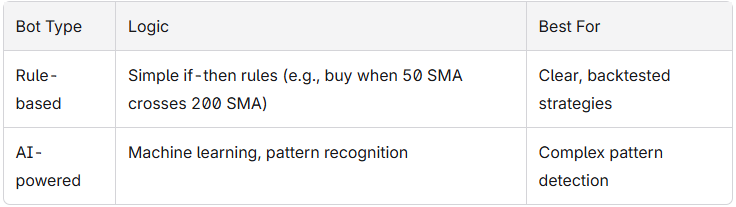
Most bots connect via API keys to crypto exchanges or stock brokers that allow algorithmic access. Critically, bots do not predict the future—they execute a strategy you define based on logic, data, and risk preferences.
How Auto Trading Bots Work Under the Hood
The typical bot workflow follows a clear sequence: data ingestion → signal generation → risk checks → order routing → position management. This happens continuously while markets are open.
Automated trading systems can execute trading strategies more quickly and consistently than human traders. Trading bots can execute trades much faster than human traders, processing large amounts of data and reacting almost instantly to market changes.
Core components include:
- Strategy logic: Entry and exit rules based on technical indicators, price action, or fundamental signals
- Position sizing: Fixed fractional or volatility-based calculations
- Risk limits: Maximum drawdown per trade, daily loss caps
- Execution engine: Order types (market, limit, OCO) and routing
Bots process real time market analysis through price feeds, order book data, and sometimes on-chain metrics depending on asset classes. The role of historical data in backtesting is crucial—bots replay past market conditions to test strategies before going live.
Many modern bot trading tools offer visual rule builders for discretionary trading automation, while technical users code in Python, JavaScript, or broker-specific languages.
Main Types of Auto Trading Bots
The best trading bots vary by market and strategy, with some optimized for crypto, others for futures or forex, and their effectiveness depends on market conditions and the quality of the underlying strategy.
Trend-Following Bots
These momentum and breakout systems excel in directional moves, buying assets showing strength and riding trends. They perform well in clear bull or bear markets but suffer whipsaw losses during consolidation.
Grid Bots
Grid bots place layered buy and sell orders within a price range. Data from Bitsgap shows grid bots yielding 15-25% annualized in sideways altcoin markets where prices oscillate without clear direction.
DCA Bots
DCA bots automate dollar-cost averaging, investing fixed amounts on schedules regardless of price. Historical analysis shows 18% better returns than lump-sum investing during the 2022 downturn, smoothing market volatility impact.
Arbitrage Bots
These exploit price differences between exchanges, requiring substantial capital ($50k+) and co-located servers for speed. Higher technical requirements limit them to experienced traders.
Portfolio Rebalancing Bots
Auto trading bots allow for the implementation of various trading strategies, including trend following and arbitrage. Rebalancers maintain target allocations across multiple asset classes, preventing drift and supporting portfolio management for long-term investors.
AI Trading Bots vs. Rule-Based Automation
Classic rule-based automated trading relies on static if-then logic—transparent and deterministic but rigid when market conditions shift. AI trading bots harness machine learning to detect patterns across large datasets and adapt dynamically.
How AI bots generate trading signals:
- Regression models for price forecasting
- Classification for buy/hold/sell decisions
- Reinforcement learning agents optimizing rewards in simulated environments
Strengths include superior pattern recognition across many indicators and the ability to scan thousands of instruments simultaneously. A 2026 study found AI models provide insights that helped achieve 65% accuracy on sentiment-based crypto trades.
However, the performance of automated trading strategies can vary significantly based on market conditions, with bots typically performing best in stable and liquid environments. Algorithmic trading bots perform best in stable, liquid market conditions where execution logic behaves predictably, and they may struggle during high volatility or regime shifts.
Models trained on 2021 bull market data often failed during the 2022 bear market, losing 70% when conditions changed dramatically.
Treat AI systems as co-pilots that assist with signal ranking and anomaly detection, not fully autonomous decision-makers.
Using Auto Trading Bots in Crypto Markets
Crypto markets operate 24/7 with high market volatility and fragmented liquidity across hundreds of venues—a natural fit for crypto bots. MEXC reports that 80% of volume comes from automated trading strategies.
Common crypto trading setups:
- DCA bots accumulating BTC/ETH regardless of short-term price movements
- Grid bots capturing oscillations in range-bound altcoins
- Trend-following bots riding breakouts during strong directional moves
Unique challenges for crypto traders include exchange outages, API rate limits (Binance caps at 1,200 requests per minute), slippage in thin markets, and sudden news-driven moves from regulatory announcements.
Risk control specific to crypto bots should include:
- Limiting per-coin exposure to 5-10% of portfolio
- Using exchange-specific stop-loss logic
- Diversifying across multiple markets and venues
- Setting automated signals for unusual activity
Many traders run multiple bots with different custom strategies to adapt across varying market conditions—ranging, trending, or high volatility periods.
Backtesting and Working With Historical Data
Backtesting capabilities allow traders to test strategies against historical data before risking real capital. This process replays your strategy against past market conditions to estimate how it might perform.
What good historical data looks like:
- High-resolution (1-minute bars or tick data)
- Minimal gaps and accurate adjustments for splits
- Coverage across different market regimes
Key performance metrics to evaluate:
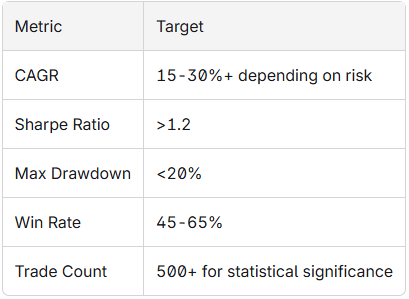
Common pitfalls include overfitting parameters to past performance, ignoring trading fees and slippage, and optimizing only on one narrow period. Use out-of-sample testing and walk-forward analysis to backtest strategies across different regimes (e.g., 2018 bear vs. 2021 bull).
Risk Management for Automated Trading
Risk controls matter more with automation because bots can scale mistakes very quickly. A flawed strategy can execute thousands of losing trades before you notice.
Position sizing approaches:
- Fixed fractional: Risk 1% of account per trade
- Volatility-based: Size inversely to ATR
Stop-loss, take-profit, and trailing stop mechanisms protect individual positions. Bots adhere strictly to preset rules for trading, eliminating psychological biases such as fear and greed that affect human traders.
Account-level protections:
- Daily loss limits (e.g., 5% of portfolio halts trading)
- Maximum open positions across connected accounts
- Emergency kill switch during abnormal conditions
Technical failures such as software bugs or exchange-side API downtime can lead to erroneous orders. Security vulnerabilities can arise when connecting a bot via API keys, potentially exposing funds to hackers. Despite being automated, trading bots require regular monitoring and strategy adjustments to remain effective.
Monitor via dashboards with email, SMS, or Telegram alerts for anomalies.
Building vs. Buying an Auto Trading Bot
Prebuilt trading bots reduce setup time but limit flexibility and transparency compared to custom-built options. Building a trading bot provides full control over logic, data inputs, and risk management, but requires technical expertise and ongoing maintenance.
Ready-made platforms offer:
- Faster setup (often under 15 minutes)
- Visual rule builders and bot marketplace options
- Pre-configured broker support and crypto exchanges integration
- Subscription plans for different feature levels
Custom builds provide:
- Full control over source code and trading algorithms
- Transparency for fine tune adjustments
- Support for niche asset classes and overall strategy customization
Building a trading bot typically involves defining the logic for entries and exits, selecting data inputs, and scripting the execution of trades. Python is a popular programming language for building trading bots due to its flexibility and access to financial libraries like CCXT, Pandas, and NumPy. You can host on cloud servers for as little as $5/month.
Many experienced traders combine both building their own bots and using prebuilt platforms to optimize their trading strategies—a smart trade approach that balances convenience with customization.
Getting Started With Your First Auto Trading Bot
In 2025, traders evaluate automated trading bots based on execution speed, customization, data access, and compatibility with algorithmic finance workflows.
Step-by-step process:
- Define a clear objective (e.g., “DCA $20 daily into BTC” or “swing trade ETH on RSI signals”)
- Write rules in plain language first, then translate to bot logic
- Choose your market and exchange, then generate API keys (read/trade only)
- Configure or code your strategy using your preferred trading platform
- Backtest on 2+ years of historical data
- Paper trade for 4+ weeks observing live markets behavior
- Go live with minimal position sizes ($100-200)
Trading bots are most effective when they automate well-defined strategies that have been validated, as they can execute trades automatically based on your rules faster and without emotional biases.
Scale only after several months of stable performance. While trading bots can enhance trading efficiency, they may struggle in volatile markets where conditions change rapidly, leading to potential losses.
FAQs About Auto Trading Bots
Are auto trading bots legal in 2026?
Auto trading bots are generally legal in major markets (U.S., EU, UK, and many Asian jurisdictions) as long as traders comply with broker and exchange terms. Regulations prohibit manipulative behaviors like spoofing or layering. Some venues restrict high-frequency or latency arbitrage strategies. Always check local securities, derivatives, and crypto regulations, and consult a qualified professional for jurisdiction-specific guidance.
How much money do I need to start using an auto trading bot?
Minimum capital depends on your market. Some stock brokers support bots from a few hundred dollars, while futures and margin crypto trading typically require more. Beginners should start with amounts they can afford to lose—often $200-$1,000 for basic crypto trading or small equity strategies. Trading fees, spreads, and minimum order sizes significantly impact small accounts and should factor into strategy design.
Can an auto trading bot guarantee profits?
No auto trading bot or AI bot can guarantee profits regardless of marketing claims. The effectiveness of algorithmic trading bots varies widely depending on the quality of the strategy, market conditions, and the type of algorithmic trading software used. Returns depend on strategy quality, execution, and evolving market conditions that are inherently uncertain. Be skeptical of “get rich quick” promises and always conduct independent backtesting.
Do I need to know how to code to use automated trading bots?
Many modern platforms offer no-code interfaces where users configure bots with visual rule builders and templates. This works well for like minded individuals in trading communities sharing signals via signal provider services. Coding skills (especially Python) become important for highly customized strategies, cross-exchange arbitrage, or proprietary research. Non-coders can start with platform tools and gradually learn scripting for deeper control.
How often should I adjust or update my trading bot?
Strategies shouldn’t change after every bad trade, but they also shouldn’t run untouched for years. Schedule reviews monthly or quarterly to assess performance against backtest expectations. Algo bots help maintain discipline and consistency in execution by removing emotional biases that often lead to poor decision-making—but you still need to monitor them. Pause or reduce risk when results deviate significantly from tested behavior, then revisit assumptions and data quality. Many traders maintain a trading journal to track adjustments and their impact on better performance. Reach out to your platform’s support team or new features announcements for updates that might benefit your setup.