


 By
By Hot Wallet Limits & Signing Workflows
What You Need Before Starting
This guide assumes you manage DeFi yield positions across multiple protocols and need operational security that balances capital protection against transaction speed. You need at least two wallets, a hardware device for signing, and a clear understanding of what constitutes acceptable hot wallet exposure for your portfolio size.
Prerequisites: active yield positions across two or more protocols, capital allocation above $10,000, and willingness to add 2-5 minutes of verification time per transaction. If you hold exclusively on exchanges, this workflow does not apply yet.
The income mechanism at stake: wallet security failures cause direct capital loss through phishing attacks, compromised seed phrases, or malicious contract approvals. Proper security hygiene prevents loss while maintaining transaction speed for rate-sensitive position changes. In 2025, phishing alone caused $722.9 million in losses across 248 incidents. Supply-chain attacks caused $1.45 billion across two incidents. These are not edge cases.
Step 1: Set Your Hot Wallet Exposure Ceiling
The first structural decision is allocation split. Hardware wallets secure 80% or more of long-term capital. Software wallets allocate 15-20% for active DeFi deployment. Exchange balances maintain 5% or less for immediate liquidity.
For a $100,000 portfolio actively deployed in DeFi, the breakdown looks like this: $80,000 in cold storage earning 5-8% annually with less than 0.1% security risk, $15,000 in hot wallet earning 12-25% with 2-3% security risk, and $5,000 on exchanges for immediate rebalancing.
The hot wallet ceiling is the maximum amount you are comfortable losing in a single phishing event or seed phrase compromise. For most individual allocators, that ceiling sits between $50,000 and $100,000. Above that threshold, the operational security friction of hardware signing and multisig workflows becomes worth the effort.
Set the ceiling based on loss tolerance, not portfolio percentage. If losing $20,000 would materially affect your financial position, your hot wallet ceiling is $20,000 regardless of whether your total portfolio is $100,000 or $500,000.
Common failure mode: allocators set percentage-based rules and fail to adjust as portfolio size grows. A 20% hot wallet allocation makes sense at $50,000 total capital. At $500,000, it puts $100,000 at elevated risk for convenience yield farming. Absolute dollar ceilings scale better than percentage rules.
Step 2: Acquire and Verify Hardware Wallet
Hardware wallets start around $50 and provide meaningful security upgrade regardless of portfolio size. The safest models use CC EAL6+ certified Secure Element chips, tested against physical extraction, side-channel attacks, and fault injection.
Top-rated hardware wallets in 2026 include Trezor Safe 7, Ledger Flex, Coldcard Q, BitBox02, and OneKey Pro. Pricing for the most common models: Ledger Nano S Plus costs $79, Ledger Nano X costs $149, Trezor Model One costs $69, and Trezor Model T costs $219.
Purchase exclusively from manufacturer websites. Never buy from third-party retailers including Amazon or eBay. Counterfeit hardware wallets pre-loaded with malware represent a documented supply-chain attack vector. Verify device authenticity using tamper-evident packaging when it arrives.
Security architecture differences matter. Ledger uses a single-chip Secure Element design that stores private keys, runs the custom OS, reads transaction data, generates the device screen display, and signs all in one protected environment. Trezor uses a multi-processor flow where the main processor parses the transaction and the Secure Element signs. Both are EAL6+ certified but represent different threat models.
After unboxing, complete these verification steps before transferring funds:
- Update firmware to the latest version (security patches release regularly; delay beyond 30 days exposes you to known vulnerabilities)
- Generate seed phrase on the device itself, never using computer-generated entropy
- Write seed phrase on paper or metal backup, never digitally
- Test recovery process by wiping device and restoring from seed phrase
- Enable passphrase feature for additional security layer beyond the 12 or 24-word seed
The test recovery process is not optional. You need confirmation that your backup works before the device holds meaningful capital. Hardware failure or user error during seed phrase recording has caused unrecoverable loss.
Step 3: Structure Multi-Wallet Architecture
A two-wallet strategy separates security risk from operational speed. Cold storage (hardware wallet) holds long-term positions and infrequently rebalanced capital. Hot wallet (software wallet like MetaMask or Rabby) holds actively managed yield positions requiring frequent rebalancing.
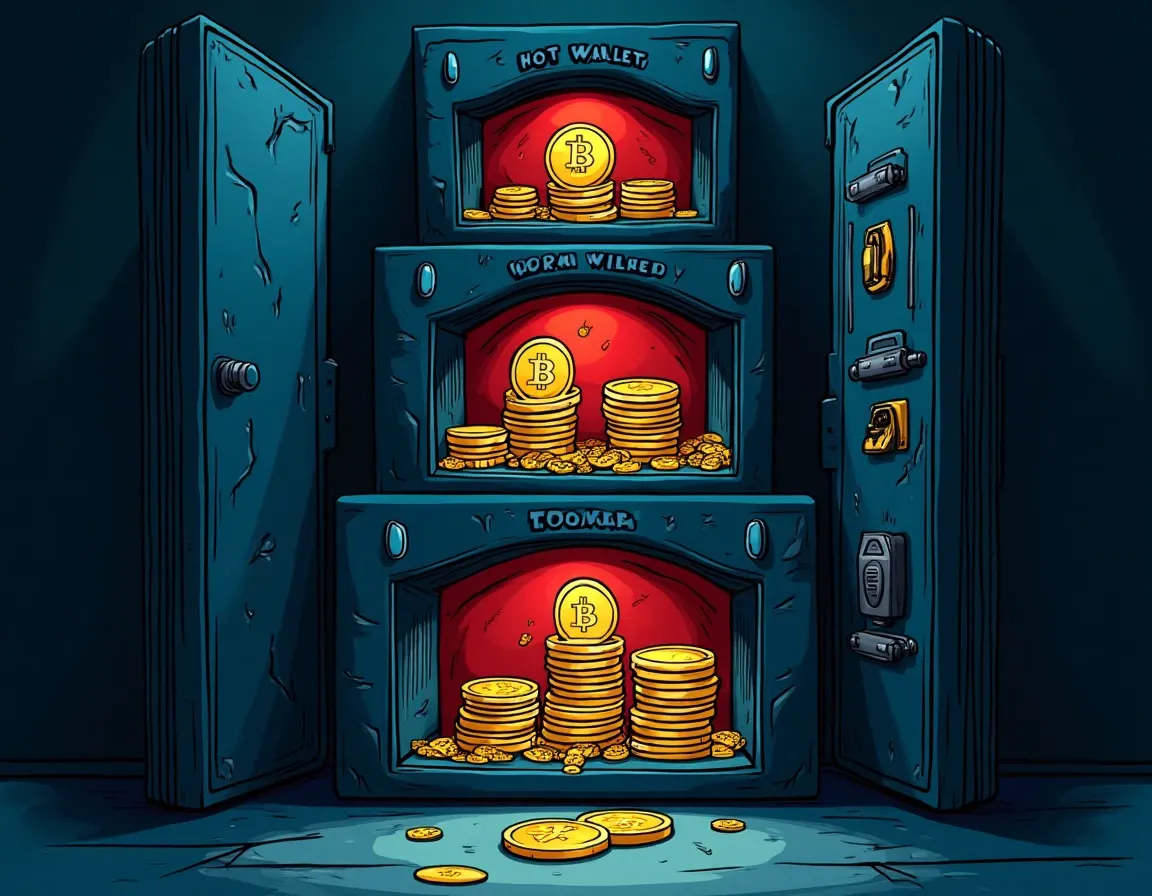
For allocators managing $200,000 to $800,000 across 8-12 yield positions, a three-wallet architecture provides better risk isolation:
- Cold storage hardware wallet: 70-80% of capital in staking positions or long-term LP positions rebalanced quarterly or less
- Warm wallet (hardware-backed MetaMask): 15-25% of capital in yield positions requiring weekly to monthly rebalancing
- Hot wallet (pure software): 5-10% of capital in high-frequency arbitrage or rate-sensitive positions requiring daily interaction
The warm wallet configuration connects a hardware device to MetaMask. When you interact with DeFi protocols through the browser extension, every transaction requires physical device approval. This combines DeFi convenience with hardware security. You can access Uniswap, Aave, and OpenSea through the standard web interface while keeping private keys on the Secure Element chip.
For institutional allocators or individuals managing above $1 million, multisig wallets replace single-signature hardware wallets for cold storage. Safe multisig wallet creation costs between 0.02 and 0.05 ETH on mainnet. A 2-of-3 or 3-of-5 configuration distributes signing authority and eliminates single points of failure.
Advanced allocators add timelocks to cold storage withdrawals. Even if a hardware wallet is compromised, attackers cannot withdraw funds immediately. A 72-hour timelock window provides time to detect unauthorized attempts, execute emergency multisig override, and move funds to a new address. This architectural layer prevents hot wallet compromise from cascading to main holdings without requiring manual intervention for every transaction.
Step 4: Verify Every Contract Interaction
The 2025 Bybit blind-signing exploit demonstrated the failure mode hardware wallets are supposed to prevent. The attacker presented a malicious transaction that appeared legitimate on the computer screen. The hardware wallet displayed only the transaction hash without human-readable details. The user approved based on what they saw in the browser, not what the device showed. The contract drained the wallet.
Clear-signing support is now a minimum security control. Your hardware wallet must display human-readable transaction details on its trusted screen before you approve. If the device shows only a hash or “Contract Interaction” without specifics, reject the transaction.
Before approving any DeFi interaction, verify these five fields:
- Contract address: matches the protocol you intend to interact with (check against blockchain explorer, not the website URL)
- Function being called: “approve”, “deposit”, “swap”, “withdraw” should match your intended action
- Token amounts: exact quantities being transferred or approved
- Approval limits: if granting token approval, verify it is not unlimited (unlimited approvals persist indefinitely and grant future access)
- Recipient address: for withdrawals or transfers, verify the destination address character by character
The verification happens on the hardware wallet screen, not your computer. Malware can compromise what you see in the browser. It cannot compromise the Secure Element display. If details on the device screen do not match your intended transaction, reject and investigate.
Smart contract verification means the source code is published and build metadata matches on-chain deployment. In 2026, this is a minimum security control because attackers actively hunt for unverified contracts. Before interacting with any protocol, check the contract verification status on the blockchain explorer. Unverified contracts obscure what the code actually does and slow defenders when exploits occur.
Common failure mode: users verify the domain name (app.protocol.fi) but not the contract address. Phishing sites use legitimate-looking domains with malicious contract addresses. The domain means nothing. The contract address is what executes.
Step 5: Manage Token Approvals Aggressively
Every DeFi interaction may grant protocols unlimited access to your tokens. These approvals persist indefinitely unless explicitly revoked. A single malicious transaction months after the initial approval can drain holdings.
When you approve a protocol to spend your USDC, you choose between limited approval (exact amount for this transaction) and unlimited approval (any amount, any time, until revoked). Unlimited approvals reduce transaction friction for protocols you use frequently. They also create permanent attack surface.
Recommended approval hygiene for active yield allocators:
- Grant limited approvals (exact amounts) for protocols used once or infrequently
- Grant unlimited approvals only for protocols with multi-year track records that you interact with weekly
- Revoke all approvals quarterly using Revoke.cash or Etherscan’s token approval interface
- After revoking, re-approve only protocols you are actively using that month
Approval accumulation is invisible until it is exploited. Allocators who farmed yield across 15 protocols in 2023 and 2024 may have 40+ active approvals they no longer monitor. Each represents a potential drainage vector if the protocol is compromised or if the user is phished into signing a malicious transaction.
The friction cost of limited approvals is one additional transaction per DeFi interaction (approve, then deposit). At current gas prices, this costs $3-8 extra per operation. For a $50,000 position earning 15% APY, the annual return is $7,500. The approval friction for 12 rebalancing operations across the year costs $36-96. The security benefit is elimination of persistent unlimited access.
Step 6: Detect and Reject Phishing Attempts
Most DeFi losses begin with bad links, fake apps, or compromised devices long before smart contract exploits. Phishing in 2025 caused $722.9 million in losses. The attack vector is a malicious website that mimics a legitimate protocol and prompts you to approve a contract that drains your wallet.
Phishing detection checklist before connecting wallet to any dApp:
- Verify the domain character by character (attackers use “app.unisawp.com” instead of “app.uniswap.org”)
- Check SSL certificate (click the padlock icon in browser; verify certificate issuer)
- Bookmark legitimate protocol URLs after verifying on official Twitter or documentation
- Access bookmarked URLs directly, never through search results or Discord links
- Review “Connected Sites” in MetaMask monthly and disconnect protocols you no longer use
Common phishing techniques in 2026 include Google Ads that place fake protocol sites above legitimate results, compromised Discord servers posting malicious links, and airdrop scams that ask you to “claim tokens” by approving a contract that drains your wallet instead.
If a dApp asks you to approve a contract you do not recognize, or if the approval request appears without you initiating an action, reject immediately and disconnect. Legitimate protocols do not request approvals unprompted.
Hardware wallet integration provides a verification layer here. Even if you click a phishing link and attempt to approve a malicious contract, the hardware wallet displays the actual contract address and function being called. If those details do not match your intended action, the device catches what the browser missed.
Step 7: Review Transaction Simulation Before Signing
Transaction simulation shows what will happen if you approve a transaction before you actually sign it. Tools like Tenderly, Fire, or MetaMask’s built-in simulation run the transaction against current blockchain state and display the outcome (tokens transferred, balances after execution, contract state changes).
For complex DeFi interactions involving multiple contract calls, simulation catches errors that manual review misses. If you intend to deposit 10 ETH into a liquidity pool and the simulation shows 10 ETH leaving your wallet with no LP tokens received, the transaction is malformed or malicious.
Simulation also estimates gas costs. For yield positions where rebalancing costs need to stay below 0.5% of position size, pre-simulating transactions prevents approving operations that would cost more than they return. A $5,000 yield position rebalanced monthly can afford $25 in gas per operation. If simulation shows $60 gas requirement, delay until network congestion drops.
The failure mode simulation prevents: you approve a transaction that technically executes as written but does not do what you intended. The contract does not steal your funds. It simply sends them to the wrong pool, or approves the wrong token, or sets parameters you did not intend. Simulation surfaces this before the transaction is irreversible.
Common Failure Modes and How to Avoid Them
Bridge risk in multi-chain yield: when you bridge assets from Ethereum to Arbitrum or Polygon, the bridged tokens are synthetic representations. The bridge contract holds your native tokens and mints wrapped versions on the destination chain. Bridges represent the highest-loss attack surface in DeFi, with over $40 billion in documented bridge hacks. Mitigation: prefer protocols that operate natively on a single chain or use MPC-based chain signatures instead of lock-and-mint bridges.
Firmware update exploitation: attackers compromise devices during the firmware update process when the Secure Element temporarily accepts unsigned code. Mitigation: update firmware only when the device is fully wiped and contains no funds, or use manufacturers that support signed firmware with hardware-enforced verification.
Multisig signing review window inadequacy: in a 3-of-5 multisig, if all five signers are on the same team and approve transactions in a 15-minute window, the multisig provides no defense against coordinated internal attack. Mitigation: distribute signing authority across parties with conflicting incentives (protocol team + investors + community representatives) and enforce minimum signing windows of 24-48 hours.
MetaMask session persistence: every time you connect MetaMask to a dApp, that site gains the ability to prompt transaction requests until you manually disconnect. If you connect to a protocol, complete your transaction, and leave the site open in a background tab, a compromised ad network or script injection can prompt malicious transactions hours later. Mitigation: disconnect wallet from sites immediately after completing transactions, or use browser extensions that auto-disconnect after 15 minutes of inactivity.
What to Do Next
If you currently manage yield positions exclusively through software wallets, your immediate next step is acquiring a hardware wallet and moving long-term holdings (positions you rebalance less than monthly) to cold storage. This takes 45 minutes and immediately removes 70-80% of your capital from daily phishing risk.
If you already use a hardware wallet for long-term holdings but sign DeFi transactions through pure software wallets, configure hardware-backed MetaMask for your yield positions above $10,000. The workflow adds 2-5 minutes per transaction but eliminates blind-signing risk.
If you manage above $500,000 in DeFi positions, evaluate multisig architecture. A Safe multisig with 2-of-3 or 3-of-5 configuration plus 72-hour timelocks on withdrawals provides institutional-grade security while maintaining operational flexibility for active yield positions.
Operational security checklist to implement this week:
- Audit current token approvals using Revoke.cash and revoke everything not actively used this month
- Review MetaMask connected sites and disconnect protocols you have not used in 30 days
- Set calendar reminder to repeat approval audit quarterly
- Bookmark legitimate protocol URLs for every DeFi position you hold
- Enable hardware 2FA (YubiKey or similar) on exchange accounts and email
For allocators managing 8-12 positions across multiple chains, the security architecture described here adds approximately 20-30 minutes of overhead per week (transaction verification, approval management, wallet connection review). The alternative is exposure to phishing attacks that caused $722.9 million in losses in 2025 alone.
The mechanism is: security practices prevent capital loss from wallet compromise while maintaining transaction speed for rate-sensitive rebalancing. The failure mode is: inadequate verification workflow or excessive hot wallet exposure allows phishing attacks or malicious approvals to drain positions faster than you can react. The specific stress condition is: one successful phishing event or compromised seed phrase when your entire portfolio sits in a software wallet with unlimited approvals across 15 protocols.
The Takeaway
Wallet security for active yield positions is not about eliminating risk. It is about isolating risk to the minimum capital required for operational speed. Hardware wallets secure 80% of holdings. Software wallets manage the 15-20% requiring daily interaction. Clear-signing verification prevents blind approvals. Aggressive approval management limits persistent attack surface.
The verification workflow (contract address check, function confirmation, amount verification, approval limit review) takes 90 seconds per transaction. The alternative is trusting that every dApp you interact with, every link you click, and every approval you grant will remain non-malicious indefinitely. In 2025, $722.9 million in losses proved that trust model does not work.
Set your hot wallet ceiling based on absolute loss tolerance. Verify every contract interaction on the hardware device screen. Revoke approvals quarterly. Bookmark legitimate protocol URLs. The friction is 20 minutes weekly. The prevented loss is your entire actively managed yield position.
Frequently Asked Questions
What is the recommended hot wallet limit for active DeFi positions?
Set your hot wallet ceiling based on absolute loss tolerance, not portfolio percentage. For most individual allocators managing yield positions, $50,000 to $100,000 represents the practical threshold where hardware signing friction becomes worthwhile. Below $10,000, pure software wallets with aggressive approval management provide acceptable risk-return tradeoff. Above $100,000, hardware-backed signing or multisig architecture becomes necessary. The ceiling is the maximum amount you are comfortable losing in a single phishing event.
How much time does hardware wallet signing add to DeFi transactions?
Hardware wallet verification adds 2-5 minutes per transaction for contract interaction review and physical device approval. For allocators managing 8-12 yield positions with weekly to monthly rebalancing, total overhead is 20-30 minutes per week. This includes contract address verification, function confirmation, amount review, and approval limit checking. Multisig workflows add 15-30 minutes due to multiple signer coordination. For rate-sensitive positions requiring immediate execution, maintain a small hot wallet allocation for speed-critical operations.
What is the difference between limited and unlimited token approvals?
Limited approvals grant a protocol access to exact token amounts for a single transaction. Unlimited approvals grant permanent access to your entire token balance until explicitly revoked. Limited approvals require two transactions per DeFi interaction (approve then deposit) costing $3-8 extra in gas. Unlimited approvals reduce friction for frequently used protocols but create persistent attack surface. If a protocol is compromised or you are phished months after the initial approval, unlimited access allows drainage without additional signing. Revoke unused approvals quarterly.
How do I verify a smart contract before approving a transaction?
Check five fields on your hardware wallet screen before approval: contract address matches the intended protocol verified on blockchain explorer, function name matches your action like deposit or swap, token amounts are exact quantities you intend to transfer, approval limits are not unlimited unless deliberately chosen, and recipient address is correct character by character. Never verify transaction details only in your browser as malware can compromise the display. Smart contract verification status on blockchain explorers confirms source code is published. Unverified contracts are red flags in 2026.
What architecture should I use for managing over $500,000 in DeFi positions?
Above $500,000, implement three-tier architecture: cold storage multisig wallet (70-80% of capital) using Safe with 2-of-3 or 3-of-5 configuration plus 72-hour timelocks on withdrawals, warm wallet (15-25% of capital) using hardware-backed MetaMask for weekly to monthly rebalancing, and hot wallet (5-10% of capital) for daily high-frequency operations. Multisig creation costs 0.02-0.05 ETH on mainnet. Distribute signing authority across parties with conflicting incentives and enforce minimum 24-48 hour signing windows to prevent coordinated internal attacks.
Tool mentioned above
Ledger
Ledger devices display the full transaction on their own screen before you approve it, which is what stops an approval exploit at the point it matters.
We may earn a commission if you sign up through this link, at no cost to you. It does not change what gets recommended.
The Weekly Yield Report
You just mapped hot wallet limits, hardware signing workflows, and verification steps that prevented $722.9 million in phishing losses in 2025. Those attack vectors evolve weekly.
Every Thursday: where crypto yield actually is – stablecoins, liquid staking and DeFi lending, with the risk named next to the rate and what changed since last week.
Free. No trade calls, no allocations, no hype. Unsubscribe in one
click.