


 By
By Position Sizing After Rate Jump
What You Are Actually Sizing

Convex Finance’s CVXCRV staking rate jumped 1.65 percentage points in a single epoch. You are reading this because you want to know how much capital to deploy before that rate compresses back down. This is the right question. Most allocators treat rate jumps as binary opportunities and size positions the way they size everything else. That approach leaves money on the table when the jump is structural, and destroys capital when the jump is temporary.
The income difference is real. A 1.65 percentage point improvement on $200,000 is $3,300 annually. On $500,000 it is $8,250. But if your deposit moves the rate against you through dilution or if the rate was never sustainable to begin with, you earn the lower rate on a larger position and the opportunity cost compounds for the entire holding period.
This article walks through the actual methodology: verifying whether the rate jump is emission-driven or utilization-driven, checking the historical volatility of the rate to distinguish signal from noise, calculating the maximum allocation before your own deposit compresses the yield, and setting position limits that survive a return to mean rates. You need three pieces of information before you size: the cause of the jump, the stability of that cause, and the TVL threshold where marginal deposits stop earning the advertised rate.
Prerequisites
You need a wallet with ETH for gas, access to Convex Finance at convexfinance.com, and either CRV tokens or CVXCRV already in your wallet. If you are converting CRV to CVXCRV for the first time, understand that this conversion is irreversible. CVXCRV cannot be converted back to CRV at 1:1. It trades on secondary markets at a variable peg that has ranged between 0.75 and 0.98 CRV over the past year. That peg risk is part of your position sizing calculation.
Step One: Verify The Cause Of The Rate Jump

Rate increases in CVXCRV staking come from two sources: emission increases and utilization changes. Emission increases are structural. Utilization changes are cyclical. You size differently for each.
Convex takes 17% of all CRV revenue generated by liquidity providers who use Convex to boost their Curve yields. Of that 17%, exactly 10% is distributed to CVXCRV stakers as CRV. The rate you see advertised is this 10% fee share divided by the total CVXCRV staked. If the numerator rises or the denominator falls, the rate rises. If Curve liquidity providers are earning more CRV because Curve’s governance voted to increase emissions to specific pools, that is structural. If CVXCRV stakers withdrew funds and reduced the denominator temporarily, that is cyclical.
Check Votium Bribes
Convex’s vlCVX holders vote on Curve gauge weights every Thursday. Protocols that want more CRV emissions directed to their Curve pools offer bribes through Votium to influence these votes. A large bribe round can temporarily inflate the CRV revenue flowing to Convex LPs, which increases the 10% fee share paid to CVXCRV stakers. This shows up as a rate jump that lasts one or two epochs and then reverts.
Go to Votium and check the most recent vote round. If you see unusually large bribes to pools that Convex LPs are heavily allocated to, the rate jump is likely bribe-driven and temporary. If bribe volume is consistent with prior rounds, the jump is more likely emission-driven or utilization-driven and may hold longer.
Check Curve Gauge Weights
Go to Curve’s governance portal and check recent gauge weight votes. If a pool where Convex holds substantial LP positions received a permanent increase in its CRV emission gauge weight, the rate jump is structural. It will persist until the next gauge weight adjustment. If no recent gauge changes occurred, the jump is either bribe-driven or caused by a temporary spike in Curve LP activity.
The difference in your sizing is this: structural rate increases justify allocations up to your maximum protocol exposure limit. Cyclical rate increases justify tactical allocations sized to capture 2-4 weeks of elevated yield before planned reallocation.
Step Two: Check Historical Rate Volatility
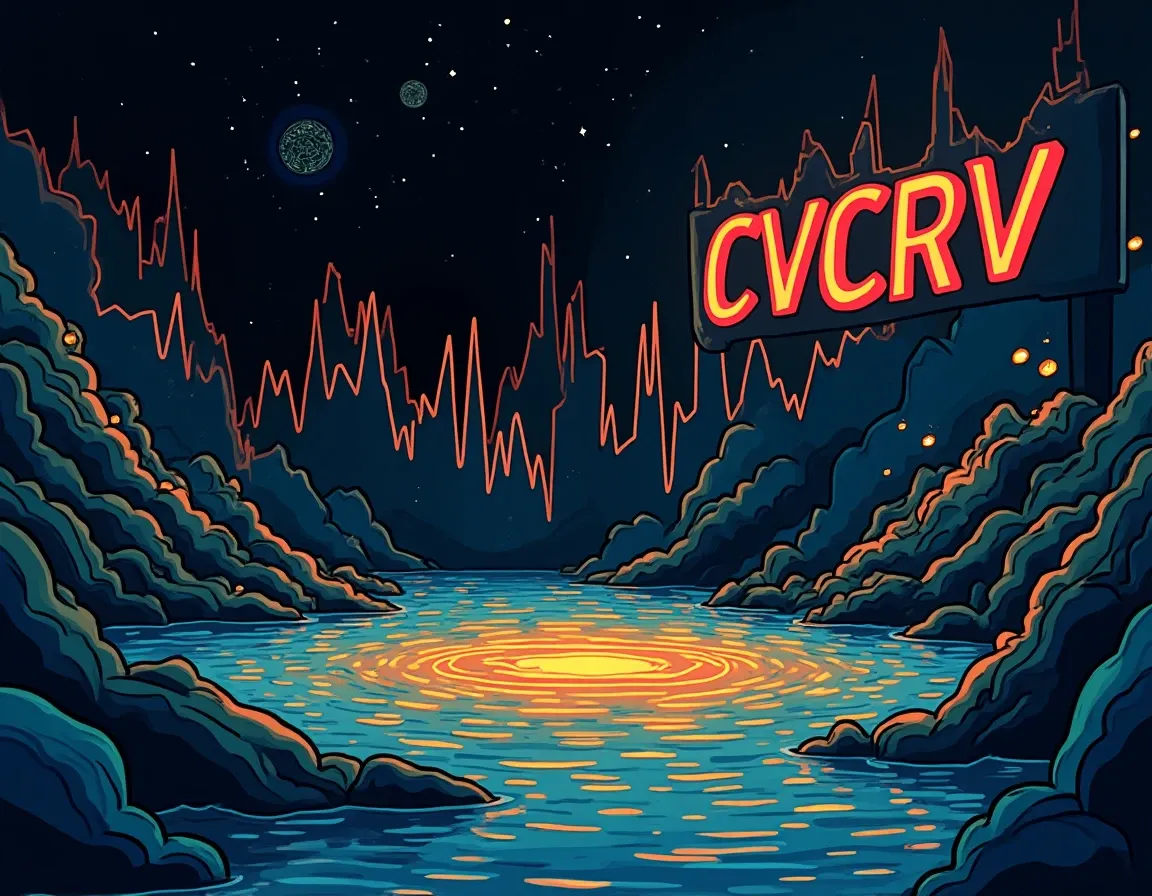
CVXCRV staking rates have ranged between 15% and 25% APY over the past 18 months according to current protocol data. A 1.65 percentage point jump within that range is noise. A 1.65 percentage point jump that takes the rate outside that range is signal.
Go to DefiLlama and pull the APY chart for Convex CVXCRV staking over the past 12 months. Calculate the standard deviation of the weekly rates. If the current rate is within one standard deviation of the mean, the jump is volatility. If it is beyond two standard deviations, the jump represents a regime change and warrants larger position sizing.
What The Standard Deviation Tells You
If the historical standard deviation is 2 percentage points and the rate jumped 1.65 points, you are seeing normal variance. Size this position the way you size any CVXCRV allocation: as part of your stable DeFi yield bucket, weighted by your overall protocol exposure limits. Do not overweight based on the jump alone.
If the historical standard deviation is 0.8 percentage points and the rate jumped 1.65 points, you are seeing a structural shift. This is the scenario where tactical overweighting makes sense, but only after you confirm the cause in Step One and calculate the dilution threshold in Step Three.
I have watched allocators chase rate jumps that were nothing more than two-week mean reversion trades. They sized positions as if the new rate was permanent, then watched the rate compress back to baseline while their capital sat locked in a now-mediocre yield. The volatility check prevents this. If the rate has historically moved this much on a regular basis, the current jump is not an opportunity. It is calendar noise.
Step Three: Calculate Your Dilution Threshold
Your deposit increases the denominator. If you are depositing $500,000 into a pool with $59 million TVL, you are increasing total staked CVXCRV by 0.85%. If the rate is driven by a fixed numerator (the 10% fee share from a stable base of Convex LP revenue), your deposit lowers the rate for everyone, including yourself.
However, current Convex TVL is $469 million on Ethereum according to DefiLlama, not $59 million. If you are sizing into the main CVXCRV staking pool on Ethereum, your dilution math changes substantially. A $500,000 deposit into $469 million TVL is 0.11% dilution. This is within the noise threshold for most rate calculations and your deposit will not materially compress the rate.
If you are sizing into a specific Convex pool with lower TVL, or if you are working with a much larger allocation, you need the exact denominator for your target pool.
The Formula
New Rate = (Current Rate × Current TVL) / (Current TVL + Your Deposit)
Run this calculation for deposit sizes at 0.5%, 1%, 2%, and 5% of current TVL. If the rate compresses by more than 0.25 percentage points at your intended allocation size, you are oversizing. The marginal yield on the incremental capital does not justify the position size.
Example: Current rate is 11.5% on $469 million TVL. You are considering a $2 million deposit.
New Rate = (11.5% × $469M) / ($469M + $2M) = 11.45%
The rate compression is 0.05 percentage points. This is acceptable. Your $2 million earns an average rate of approximately 11.48% (midpoint between entry rate and new equilibrium rate), which is $229,600 annually. If you had sized at $10 million:
New Rate = (11.5% × $469M) / ($469M + $10M) = 11.26%
The rate compression is 0.24 percentage points. You are at the edge of acceptable dilution. Your $10 million earns an average rate of approximately 11.38%, which is $1,138,000 annually. But you have deployed five times the capital for 4.96 times the income. The marginal efficiency is declining.
This is the threshold. Beyond this deposit size, you are compressing your own yield faster than you are scaling your income.
Step Four: Model The Peg Risk
CVXCRV is not CRV. It trades at a variable peg that has ranged from 0.75 to 0.98 CRV over the past year. A 1.65 percentage point rate increase can be entirely offset by a 1.65 percentage point depeg if you need to exit before the peg recovers.
The peg risk comes from two sources: liquidity depth in the CVXCRV/CRV Curve pool, and market sentiment about Convex’s long-term value proposition. When CVXCRV staking rates rise, new deposits increase demand for CVXCRV. If those deposits come from CRV conversions (irreversible), the CVXCRV supply increases and the peg can weaken. If those deposits come from secondary market purchases of CVXCRV, the peg can strengthen temporarily but liquidity depth matters.
Check The Curve Pool Depth
Go to the CVXCRV/CRV pool on Curve. Check the liquidity depth in both directions. If the pool holds less than $20 million in liquidity and you are depositing $500,000 or more, your exit will move the price. A 2% slippage on exit erases two years of a 1% rate advantage. This matters.
Run a simulated trade on Curve’s interface for your intended position size. If the estimated slippage exceeds 0.5%, your position is too large for the current liquidity. Either reduce your size or plan to hold for a minimum of 18-24 months to amortize the entry and exit friction across enough yield to justify the position.
Model The 0.98 to 0.75 Scenario
Assume you deposit $200,000 when the CVXCRV/CRV peg is at 0.95. You earn 11.5% for one year, which is $23,000. The peg drops to 0.80 because Curve governance changes reduce the attractiveness of Convex’s value proposition. Your position is now worth $168,421 in CRV terms ($200,000 / 0.95 × 0.80). You lost $31,579 in peg value. The yield did not cover the depeg.
This is the risk. Rate jumps attract deposits. Deposits can destabilize the peg if liquidity is shallow or if the rate jump was never structural. You must size your position such that the yield you earn over your minimum holding period exceeds the maximum reasonable depeg scenario.
I use 0.85 as my floor peg assumption for CVXCRV. If the rate advantage over the next-best equivalent-risk alternative is less than 15% cumulative over my intended holding period, I do not overweight CVXCRV relative to that alternative. The peg risk is not worth it.
Step Five: Set Your Maximum Allocation
You now have four constraints:
- The cause of the rate jump (structural vs. cyclical)
- The historical volatility of the rate (signal vs. noise)
- The dilution threshold (how much you can deposit before compressing your own yield)
- The peg risk (exit liquidity and depeg scenarios)
Your maximum allocation is the smallest of these four constraints.
Structural Jump, Low Volatility, High TVL, Deep Liquidity
If the rate jump is emission-driven, the historical standard deviation is low, the TVL is $469 million, and the CVXCRV/CRV pool holds $30 million in liquidity, you can size this position up to your protocol exposure limit. For most allocators, that is 10-15% of total portfolio. On a $2 million portfolio, that is $200,000 to $300,000.
Cyclical Jump, High Volatility, Moderate TVL, Shallow Liquidity
If the rate jump is bribe-driven, the historical standard deviation is high, the TVL is $59 million, and the CVXCRV/CRV pool holds $8 million in liquidity, you size this as a tactical 2-4 week position. Allocate no more than 3-5% of portfolio, set a calendar reminder to review the rate in two weeks, and plan to reallocate if the rate reverts to mean.
My Sizing Framework
I do not allocate more than 12% of my DeFi yield portfolio to any single protocol, regardless of rate. Convex is a mature protocol with strong audit history and $469 million TVL, but it is still smart contract risk and governance risk. A 1.65 percentage point rate jump does not change my protocol exposure limit.
Within that 12% limit, I weight my allocation based on the sustainability of the rate. If the jump is structural and supported by gauge weight changes, I move to the top of my range. If the jump is bribe-driven, I allocate 4-6% and plan to rotate out within 30 days if the rate compresses.
I also compare the rate to equivalent-risk alternatives. Other DeFi protocols offer 8-12% on stablecoin deposits or equivalent-duration lockups. If CVXCRV is paying 11.5% and Aave USDC is paying 9%, the 2.5 percentage point premium must be worth the peg risk and the irreversibility of the CRV-to-CVXCRV conversion. On $200,000, that premium is $5,000 annually. If I assess peg risk at 5% annual probability of a 10% depeg, the expected cost is $1,000. The premium covers the risk. If the premium were only 1 percentage point, it would not.
Common Failure Modes
Three mistakes destroy returns in this scenario.
Sizing On Rate Alone
Allocators see 11.5% and deploy the same size they would deploy to any 11.5% yield. They ignore the cause, the volatility, the dilution, and the peg risk. Two weeks later the rate is back to 9.8% and they are holding a position sized for a rate that no longer exists. The opportunity cost of that capital sitting in a now-mediocre yield is the actual loss.
Ignoring The Peg
Allocators convert CRV to CVXCRV at a 0.95 peg, earn yield for six months, then discover the peg is at 0.82 when they need liquidity. The round-trip cost erases a year of yield. This is the irreversibility penalty. You cannot convert back to CRV at 1:1. You must sell CVXCRV on the secondary market at whatever price the market offers. If liquidity is shallow or sentiment is poor, that price is painful.
Chasing Without Reviewing
Allocators deploy capital into the rate jump, then never review the position. The rate reverts to mean after three weeks. They hold for six months at the lower rate, earning less than they would have earned in a stable alternative, because they never set a review trigger. Systematic position monitoring prevents this. Set a calendar reminder to check the rate every two weeks for the first two months after deployment. If the rate compresses below your entry threshold, reallocate.
What To Do After You Deploy
You have sized your position. You have deployed. Now you need to monitor three metrics.
Rate Stability
Check the CVXCRV staking rate weekly for the first month, then biweekly after that. If the rate drops by more than 0.5 percentage points and holds there for two consecutive weeks, the jump was temporary. Evaluate whether the current rate still justifies your allocation relative to alternatives. If not, exit and reallocate.
Peg Stability
Check the CVXCRV/CRV peg weekly. If the peg drops below 0.90 and you entered above 0.93, your exit is now underwater in CRV terms even if you earned yield. This does not mean you must exit immediately, but it does mean your minimum holding period just extended. You need to earn enough additional yield to cover the peg loss before exit becomes rational.
TVL Changes
If TVL increases by more than 20% in a single month, the rate will compress unless the numerator (CRV revenue to Convex LPs) increases proportionally. Monitor TVL on DefiLlama. A sudden TVL spike is a leading indicator of rate compression, and it gives you 1-2 weeks to decide whether to hold through the compression or rotate to an alternative.
The Takeaway
A 1.65 percentage point rate jump is worth real money if the rate holds and your position is sized correctly. It is worth nothing if the rate reverts in two weeks and you deployed maximum size. The difference between these outcomes is methodology. Verify the cause, check the volatility, calculate the dilution threshold, model the peg risk, and set your allocation to the smallest of those four constraints. Then monitor weekly and reallocate if the assumptions break. That is how you capture rate jumps without getting trapped in positions sized for rates that no longer exist.
You have just reviewed the four-step framework for sizing into a 1.65pp yield increase on CVXCRV. Those rate dynamics will change with the next governance vote, the next bribe round, and the next TVL shift.
Frequently Asked Questions
How do I know if a CVXCRV rate jump is temporary or permanent?
Check two sources: Votium bribe volumes and Curve gauge weight votes. If the rate jump coincides with unusually large Votium bribes, it is likely temporary and will revert after 1-2 epochs. If the jump follows a permanent gauge weight increase voted by Curve governance, it is structural and will persist until the next gauge adjustment. Structural jumps justify larger allocations. Temporary jumps justify tactical 2-4 week positions only.
What is the maximum amount I can deposit before I compress the CVXCRV rate?
Use this formula: New Rate = (Current Rate × Current TVL) / (Current TVL + Your Deposit). Run this calculation at 0.5%, 1%, 2%, and 5% of current TVL. If your deposit compresses the rate by more than 0.25 percentage points, you are oversizing. On $469 million TVL at 11.5%, a $2 million deposit compresses the rate by 0.05 percentage points, which is acceptable. A $10 million deposit compresses it by 0.24 percentage points, which is the upper threshold.
How do I account for CVXCRV peg risk when sizing my position?
Check the CVXCRV/CRV Curve pool liquidity depth. If it holds less than $20 million and you are depositing $500,000 or more, your exit will experience significant slippage. Model a worst-case depeg scenario from 0.95 to 0.80. If the cumulative yield over your minimum holding period does not exceed the potential depeg loss, reduce your position size. I use 0.85 as my floor peg assumption and require at least 15% cumulative yield advantage over alternatives to justify overweighting CVXCRV.
Should I convert CRV to CVXCRV or buy CVXCRV on the secondary market?
This depends on the current peg. If CVXCRV is trading at 0.90 CRV or below, buying on the secondary market gives you a discount and avoids irreversible conversion. If the peg is at 0.98 or above, converting CRV directly is more efficient. Remember that CRV-to-CVXCRV conversion is permanent and cannot be reversed. You can only exit by selling CVXCRV on secondary markets at whatever peg exists at that time. Factor exit liquidity and potential depeg into your entry decision.
How often should I review my CVXCRV position after a rate jump?
Check the rate weekly for the first month after deployment, then biweekly after that. If the rate drops by more than 0.5 percentage points and holds there for two weeks, the jump was temporary. Also monitor the CVXCRV/CRV peg weekly and TVL changes monthly on DefiLlama. A 20% TVL increase in one month without proportional revenue increase signals coming rate compression. Set calendar reminders for these reviews and reallocate if your entry assumptions no longer hold.
The Weekly Yield Report
You have just reviewed the four-step framework for sizing into a 1.65pp yield increase on CVXCRV. Those rate dynamics will change with the next governance vote, the next bribe round, and the next TVL shift.
Every Thursday: where crypto yield actually is – stablecoins, liquid staking and DeFi lending, with the risk named next to the rate and what changed since last week.
Free. No trade calls, no allocations, no hype. Unsubscribe in one
click.