


 By
Why It Jumped 15.14 Points
What Caused The 15.14 Point APY Spike

The Uniswap V3 WETH-USDT pool jumped from 3.93% to 19.07% in a matter of days. That 15.14 percentage point increase occurred on roughly $95 million in total value locked. The immediate cause is always the same: more swap volume per dollar of liquidity.
When traders execute large ETH buys or sells, they pay fees to liquidity providers. In the 0.05% WETH-USDT pool, every $100 million in swaps generates $50,000 in fees. If that volume arrives in one day instead of five, the annualized yield calculation spikes.
You need to distinguish two scenarios. One is a temporary volume surge that fades within a week. The other is a structural shift in how traders route orders. Only the second scenario justifies repositioning capital.
A temporary spike happens when a single large trader or liquidation event drives $50-100 million through the pool in 24 hours. The APY calculation extrapolates that 24-hour fee income to an annual rate. If the next day returns to normal volume, the displayed APY collapses.
A structural shift occurs when competing liquidity pools lose market share, when Ethereum volatility enters a sustained higher regime, or when a protocol change redirects retail flow. These shifts can persist for weeks or months.
The WETH-USDT spike to 19.07% sits on the edge. Ethereum experienced elevated volatility during the period in question, and elevated volatility produces elevated swap volume. The question is whether that volatility regime persists or whether a single event caused the spike.
How To Verify If The Spike Is Sustainable
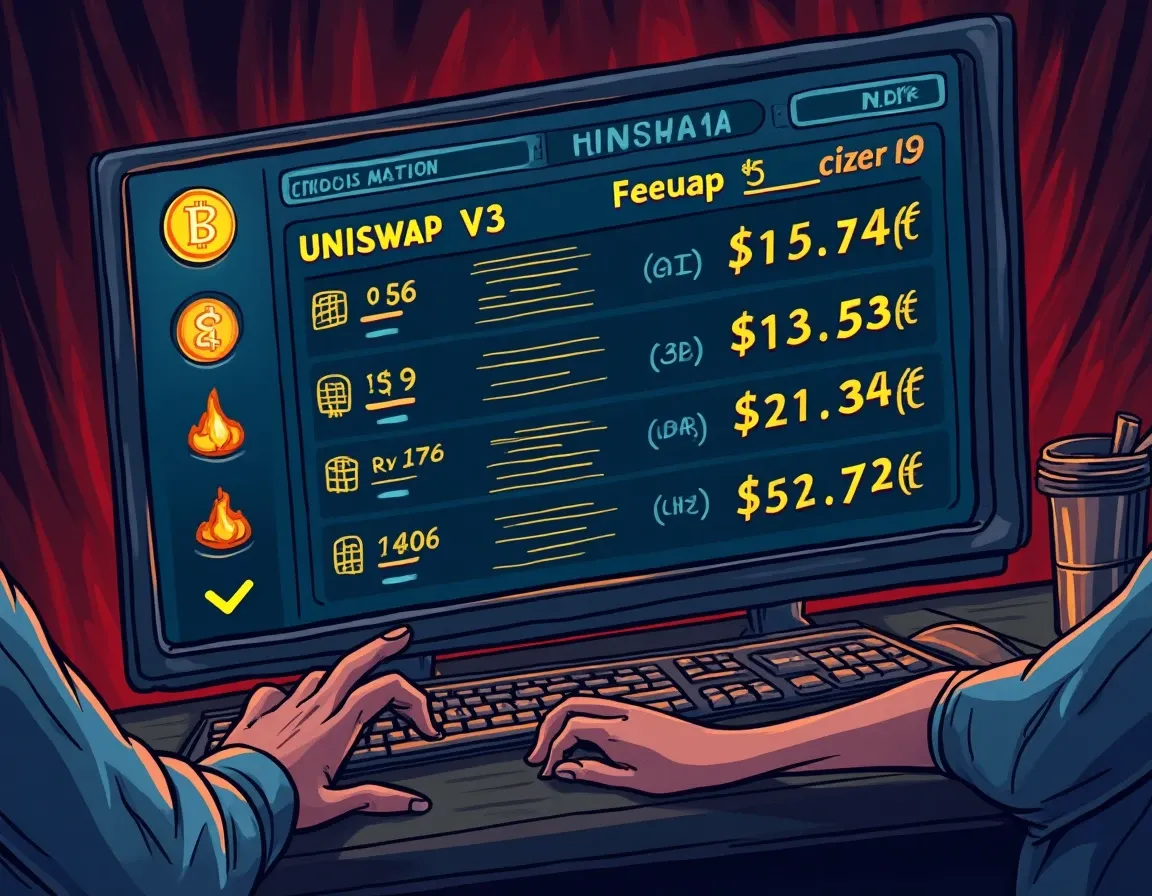
You need on-chain volume data and historical comparison. Start with the Uniswap subgraph or a tracker like DefiLlama’s Uniswap V3 page. Pull daily swap volume for the WETH-USDT 0.05% pool for the prior 30 days.
Calculate the 7-day moving average volume before the spike and compare it to the 7-day moving average during the spike. If volume doubled and stayed doubled for at least five days, the spike has a foundation. If volume spiked for one or two days and then reverted, the APY will follow within 48 hours.
Next, check liquidity concentration across fee tiers. Uniswap V3 offers 0.01%, 0.05%, 0.3%, and 1% fee tiers for WETH-USDT. The 0.05% tier typically holds the majority of retail volume, while the 0.3% tier captures high-volatility swaps and arbitrage.
If the 0.05% pool TVL dropped sharply while the 0.3% pool TVL rose, that signals liquidity migration during volatility. Liquidity providers moved capital to capture higher per-trade fees when volatility increased. That migration is usually temporary. Once volatility subsides, liquidity flows back to the 0.05% tier.
If the 0.05% pool TVL remained stable or increased, the spike reflects higher swap volume, not liquidity reallocation. That is the more durable scenario.
Third, verify the percentage of positions currently out of range. Uniswap V3 analytics tools show this metric. When more than 40% of liquidity positions are out of range, it means price moved aggressively and many concentrated positions stopped earning fees.
A spike driven by volatility often leaves 50-60% of positions out of range. New entrants who size into the pool during the spike inherit that volatility. They face the same risk of their position going out of range before they capture enough fees to justify the impermanent loss.
Position Sizing Framework When APY Surges 15 Points

You are evaluating a position that could earn 19% instead of 4%. On $300,000, that difference is worth $45,000 annually. The question is how much capital to allocate given impermanent loss risk and the probability that the rate reverts.
Start by calculating the break-even holding period. Assume you deploy $100,000 into a narrow range position at 19% APY. Gas costs for entry, one rebalancing, and exit total approximately $150-300 depending on network congestion. You need to earn that back in fees before the position is profitable.
At 19% APY, $100,000 earns $52 per day. Gas break-even occurs in 3-6 days. If the spike lasts less than one week, small positions lose money after gas.
Next, model impermanent loss at realistic ETH price moves. A concentrated position in a 5% range around the current price will go fully out of range if ETH moves 5% in either direction. A 10% price move generates roughly 1% impermanent loss in a full-range position, but 3-5% impermanent loss in a narrow concentrated range.
If ETH moves 10% during a two-week hold, you incur 3-5% impermanent loss on the position. On $100,000, that is $3,000-5,000. At 19% APY, you earn $1,038 per week, or $2,076 in two weeks. The impermanent loss exceeds the fee income.
That math changes if the rate persists for 30 days. Thirty days at 19% generates $4,583 in fees, which exceeds 3% impermanent loss and covers gas. But you need high confidence the rate holds for a month.
Here is the framework. Risk only the portion of capital where a 5% impermanent loss is acceptable. For most allocators, that means 60-80% of intended capital in a narrow range, with the remaining 20-40% in a full-range position as a hedge.
The full-range position earns lower APY because it competes with more liquidity, but it continues earning fees when price moves outside the narrow range. This structure caps your upside but limits the risk of earning zero fees if volatility persists.
Set entry triggers before deploying. A rational entry requires three conditions: sustained volume above $50 million in 24 hours, fewer than 40% of positions out of range, and confirmation that TVL in the pool is stable or increasing. If all three hold, the spike has structural support.
When To Exit A Volatility-Driven Yield Position
You need exit rules before entry. The first exit trigger is time-based. If the APY holds above 15% for seven days, you have confirmation of a structural shift. At that point, exit 50% of the position and lock in profit. The remaining 50% stays deployed to capture upside if the rate continues.
The second trigger is rate-based. If the displayed APY drops 50% from peak, exit the entire position. A drop from 19% to 9.5% signals that volume is reverting or that new liquidity entered and diluted the yield. A pool showing 50% APR when you check it may show 5% APR a week later because $100 million in new deposits arrived and diluted the yield.
The third trigger is volume-based. If 24-hour swap volume falls below the 7-day average by more than 30%, exit immediately. That indicates the volatility event ended and traders reduced activity. APY will follow volume down within 24-48 hours.
The fourth trigger is range-based. If price moves to within 30% of your position’s upper or lower bound, rebalance or exit. Waiting until the position goes fully out of range means you earn zero fees while still holding impermanent loss exposure.
For the WETH-USDT spike to 19.07%, the exit decision depends on whether Ethereum volatility remains elevated. Historical data shows that WETH pool APY spikes of 10+ percentage points revert to baseline within 7-14 days unless a macro catalyst sustains volatility.
Common Mistakes When Chasing APY Spikes
The first mistake is overallocating to small pools. A $95 million TVL pool can absorb $5-10 million in new liquidity before yield dilution becomes severe. If you deploy $500,000 into a pool with $95 million TVL, you represent 0.5% of the pool. That is manageable. But if ten other allocators do the same, the pool TVL rises 5% and the APY drops proportionally.
The second mistake is ignoring gas costs on small positions. A $10,000 position earning 19% APY generates $1,900 annually, or $158 per month. If you rebalance twice in that month and pay $150 per transaction, you spent $300 to earn $158. The position is underwater before accounting for impermanent loss.
Gas efficiency requires a minimum position size. For Ethereum mainnet Uniswap V3, that minimum is roughly $50,000 if you plan to rebalance more than once per month. Below that threshold, use a passive full-range position or deploy on a Layer 2 where gas costs are sub-$1.
The third mistake is entering after the spike is already visible on aggregator dashboards. By the time a 19% APY appears on DefiLlama or a similar tracker, other allocators have seen it too. If the spike occurred three days ago and you are seeing it now, you are likely entering as the rate peaks and volume begins to revert.
The better approach is to monitor volume directly using on-chain data and enter positions before the aggregators reflect the spike. That requires setting up alerts on swap volume or fee accrual, which most retail LPs do not do.
The fourth mistake is confusing displayed APY with net APY after impermanent loss. The 19.07% rate assumes zero impermanent loss. If ETH moves 15% against USDT during your hold period, your net return may be 10-12% or lower. Real revenue and fees beat narrative and TVL as valuation signal, and the same applies to yield strategies.
What To Watch After Entering A Position
Once deployed, monitor three metrics daily: 24-hour swap volume, percentage of liquidity in range, and fee accrual per dollar of TVL. Most Uniswap analytics dashboards provide these numbers.
Swap volume tells you whether the spike is fading. If volume drops 20% day-over-day for two consecutive days, the spike is over. Plan your exit.
Percentage of liquidity in range tells you how many other LPs are still earning fees. If that percentage drops below 50%, it means price volatility pushed half the pool out of range. Your position is at risk of the same. Tighten your rebalancing trigger or widen your range.
Fee accrual per dollar of TVL shows whether new liquidity is entering the pool. If TVL rises 10% but total fees remain flat, your share of fees drops 10%. That dilution can erase the benefit of the spike.
You should also monitor competing pools. Uniswap V3 USDC-WETH experienced a similar 6.8-point spike during the same period. If USDC-WETH yields rise while WETH-USDT yields fall, it signals traders shifting to the USDC pair. That shift can be permanent if USDC becomes the preferred trading pair for ETH.
How Long Volatility-Driven Spikes Typically Last
Historical data from prior WETH-USDT spikes shows a median duration of 5-9 days. A minority of spikes, roughly 20%, persist beyond two weeks. Those longer spikes coincide with sustained macro volatility events, regulatory announcements, or Ethereum network upgrades.
The 15.14 point spike to 19.07% falls into the top quartile of historical spikes by magnitude. That suggests either an unusually large liquidation event or the start of a higher volatility regime. The distinction matters for position duration.
If the spike was driven by a single liquidation or a one-time large swap, it will revert within one week. If it was driven by a shift in market structure, such as increased institutional ETH trading or a macro catalyst, it could persist for three to four weeks.
You can differentiate the two by checking whether volatility is isolated to WETH-USDT or whether other ETH pairs show similar spikes. If WBTC-WETH, USDC-WETH, and DAI-WETH all spiked simultaneously, the cause is Ethereum-wide volatility. That type of volatility tends to persist longer.
If only WETH-USDT spiked and other pairs remained stable, the cause is likely specific to USDT liquidity or a large trader routing through that particular pool. That type of spike fades faster.
Is 19% Sustainable Or A Temporary Anomaly
A 19% APY on a stablecoin-ETH pair is not sustainable over a multi-month period unless Ethereum enters a prolonged high-volatility regime. For context, the 0.05% WETH-USDT pool historically trades in a 4-12% APY range. Spikes above 15% occur, but they revert to the 8-10% range within two weeks in most cases.
The baseline sustainable rate for WETH-USDT depends on Ethereum’s realized volatility. During low-volatility periods, APY trends toward 4-6%. During moderate volatility, it rises to 8-12%. During high volatility, it can reach 15-20% for short periods.
Realized volatility for Ethereum over the past 90 days determines which regime you are in. If 30-day realized volatility is above 60%, you are in a high-volatility regime and the spike may hold for two to three weeks. If it is below 40%, the spike is an outlier and will revert within one week.
You can check realized volatility using on-chain analytics platforms or traditional volatility indexes for ETH. Most show a clear correlation between realized vol and Uniswap WETH pool APYs.
The other factor is new liquidity. If $30-50 million in new TVL enters the pool chasing the 19% rate, the APY will compress back toward 12-14% even if volume remains elevated. Liquidity migration is the primary driver of APY compression in Uniswap V3 pools.
The Takeaway
The 15.14 point spike to 19.07% APY reflects elevated swap volume per dollar of liquidity, driven by Ethereum volatility. Sustainability depends on whether volume holds above $50 million daily for at least seven consecutive days and whether new liquidity enters and dilutes the yield. Position sizing should assume the spike reverts within two weeks unless volatility regime shifts are confirmed. A $100,000 allocation earns $3,650 in two weeks at 19% APY, but only if you enter early, set tight rebalancing triggers, and exit before the majority of new liquidity arrives. Gas costs and impermanent loss erase the advantage on positions below $50,000 or hold periods under ten days.
You have just compared the mechanics behind a 15.14 percentage point APY spike, the sustainability checklist, and the position sizing framework for volatility-driven yields. Those numbers will be different next week.
Frequently Asked Questions
What causes a Uniswap V3 APY to spike 15 percentage points in one week?
APY spikes occur when swap volume increases faster than liquidity. In Uniswap V3, liquidity providers earn a percentage of each trade. If $100 million in swaps occurs in 24 hours instead of spread over a week, the annualized yield calculation spikes. The spike can be temporary, driven by a single large trade or liquidation, or structural, driven by sustained volatility or liquidity migration from competing pools. Verification requires checking 7-day moving average volume and confirming whether the volume increase persists beyond three days.
How do I determine if a 19% WETH-USDT APY is sustainable or temporary?
Pull daily swap volume data for the prior 30 days from the Uniswap subgraph or DefiLlama. Compare the 7-day moving average before and during the spike. If volume doubled and held for at least five days, the spike has a foundation. Check whether TVL remained stable or increased. If TVL rose sharply, new liquidity is diluting the yield and the APY will compress. Check the percentage of positions out of range. If more than 40% are out of range, volatility is high and the spike is likely temporary.
What position size is appropriate when APY jumps from 4% to 19%?
Risk only capital where 5% impermanent loss is acceptable. Deploy 60-80% of intended capital in a narrow range position and 20-40% in a full-range position as a hedge. Minimum position size should be $50,000 on Ethereum mainnet to ensure gas costs for entry, rebalancing, and exit do not exceed fee income. Smaller positions should use Layer 2 deployments where gas is under $1. Set entry triggers: volume above $50 million in 24 hours, fewer than 40% of positions out of range, and stable or increasing TVL.
When should I exit a volatility-driven yield position in Uniswap V3?
Exit 50% of the position after seven days if APY holds above 15%. Exit the entire position if APY drops 50% from peak, if 24-hour volume falls 30% below the 7-day average, or if price moves within 30% of your range boundary. A drop from 19% to 9.5% signals volume reversion or new liquidity dilution. Waiting until the position goes out of range means zero fee income while still holding impermanent loss exposure.
How long do WETH-USDT APY spikes typically last?
Historical data shows a median duration of 5-9 days for WETH-USDT APY spikes above 15 percentage points. Roughly 20% of spikes persist beyond two weeks, typically when Ethereum enters a sustained high-volatility regime or a macro catalyst drives trading activity. Spikes caused by single liquidation events or isolated large trades revert within one week. Check whether other ETH pairs show similar spikes. If WBTC-WETH, USDC-WETH, and DAI-WETH all spiked simultaneously, the cause is Ethereum-wide volatility and the spike may persist longer.
The Weekly Yield Report
You have just compared the mechanics behind a 15.14 percentage point APY spike, the sustainability checklist, and the position sizing framework for volatility-driven yields. Those numbers will be different next week.
Every Thursday: where crypto yield actually is – stablecoins, liquid staking and DeFi lending, with the risk named next to the rate and what changed since last week.
Free. No trade calls, no allocations, no hype. Unsubscribe in one
click.