

 By
By Weekly Yield Report: 15 October 2026
Six venues dropped from the dataset this week, most of them high-emission LP pools. Sky introduced two new offerings, and Compound’s USDC pool climbed back above 5.7%.
Stablecoin Yields
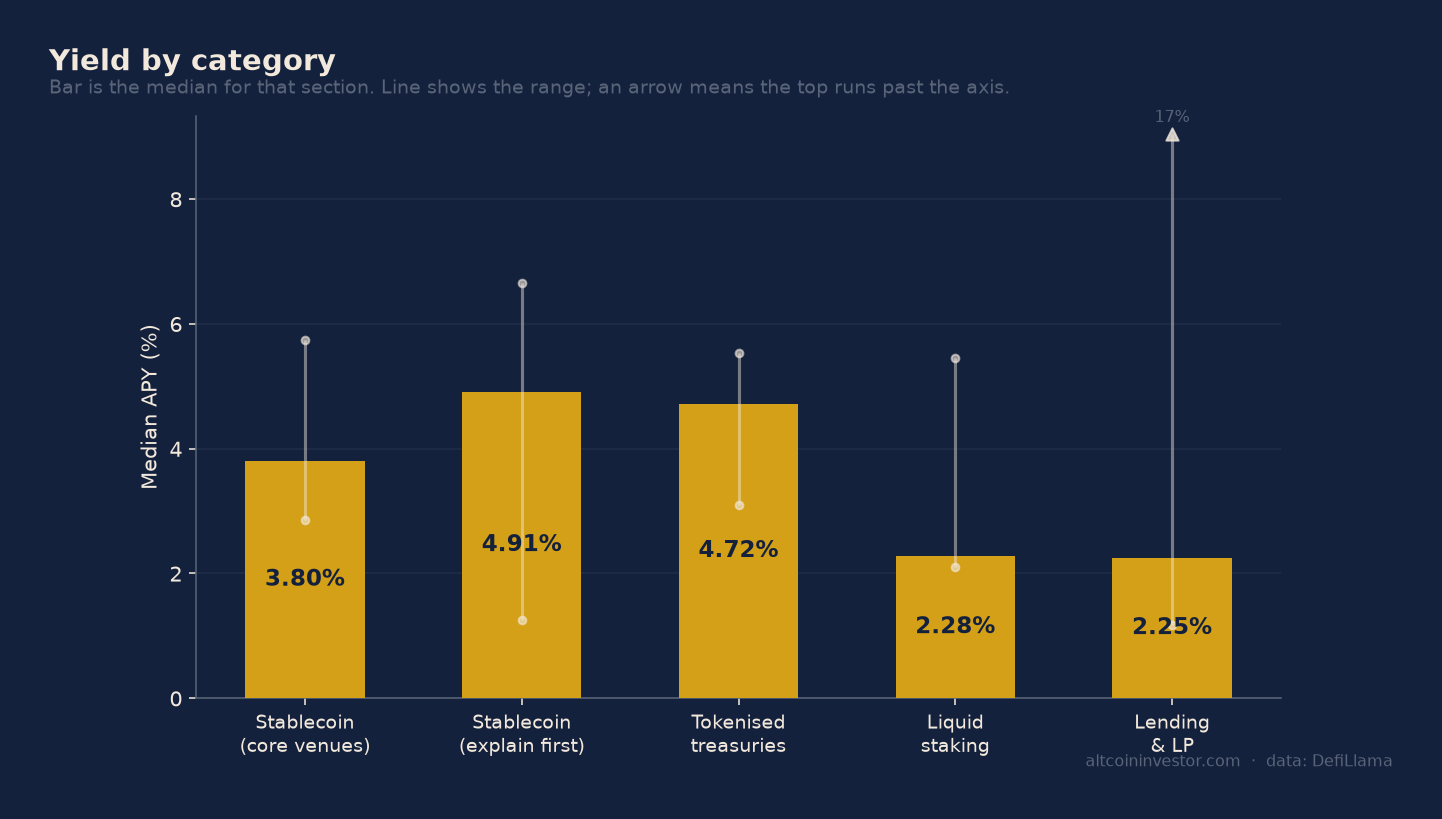
As of 15 October 2026, the core stablecoin venues continue to cluster between 3.3% and 5.8%. Sky SUSDS on Ethereum and Arbitrum pays 3.8% across $5,292M in TVL, with a 601-day track record. Spark Savings USDT on Ethereum pays 3.75% on $722M. Aave v3 USDT on Ethereum sits at 3.31% on $408M. Aave v3 USDC across four chains (Ethereum, Arbitrum, Base, Polygon) pays 3.81% on $278M in TVL.
Aave v3 SGHO on Ethereum offers 4.5% on $227M. Sky’s new STUSDS offering pays 5.6% on $180M, though it carries only a 95-day history. Compound v3 USDC on Ethereum climbed to 5.74% on $35M in TVL, with the longest track record in the set at 1,463 days.
Among venues requiring mechanism explanation, Ethena sUSDe on Ethereum pays 4.91% on $1,201M. This yield is funding-rate dependent and can go negative in a bear market. Sparklend USDS on Ethereum offers 4.0%, but 100% of that APY comes from emissions rather than base yield.
Morpho Blue vaults GTUSDCP and STEAKUSDC both pay 4.75% on $730M and $476M respectively. These are Morpho vaults where risk parameters are set by the curator, not the protocol. Jupiter lend USDC on Solana pays 6.18% (5.81% base plus 0.37% rewards) on $490M. This is Solana lending, which carries a different chain risk profile to Ethereum.
Fluid lending USDC across three chains (Ethereum, Arbitrum, Base) pays 6.66% on $202M. Fluid is a newer lending design with a shorter track record than Aave. Sky lending USDS on Ethereum pays 5.78% on $143M, but 100% of that APY is emissions.
Tokenised Treasuries And Credit
Maple USDC on Ethereum pays 5.2% on $2,776M as of 15 October 2026. This is institutional credit and carries real borrower default risk, not smart-contract risk. Ondo’s USDY (tokenised US Treasuries) pays 3.68% on $1,437M across Ethereum and Solana. BlackRock’s BUIDL pays 3.79% on $1,333M across Solana, Ethereum and Polygon.
Maple USDT on Ethereum offers 5.54% on $738M, again with borrower default risk rather than protocol risk. Invesco’s USTB pays 3.57% on $603M. Maple USDG on Ethereum pays 4.91% on $519M.
Usual’s BUSD0 on Ethereum pays 4.72% on $504M, but 100% of that APY is emissions. This is a treasury-backed product with a token incentive layer. Centrifuge USDS on Ethereum pays 3.09% on $327M, backed by tokenised real-world credit.
The distinction between these venues and the stablecoin lending pools is counterparty and regulatory risk. You are exposed to borrowers, issuers, and legal structures, not just smart contracts.
Liquid Staking
Ethereum staking rates remain compressed between 2.11% and 2.28% as of 15 October 2026. Lido stETH pays 2.25% on $22,630M. Binance wBETH pays 2.24% on $8,230M, though this is exchange-operated and carries custodial counterparty risk. Ether.fi weETH pays 2.22% on $5,215M and includes restaking exposure on top of staking. Rocket Pool rETH pays 2.11% on $1,220M. Coinbase cbETH pays 2.27% on $454M. Stakewise osETH pays 2.28% on $367M.
Solana liquid staking rates are structurally higher. Jupiter jupSOL pays 5.45% on $529M. Jito jitoSOL pays 4.57% on $1,056M and includes MEV rewards. Drift dSOL pays 5.01% on $283M. Marinade mSOL pays 4.88% on $229M. Solana’s higher staking yield reflects a different inflation schedule and validator economics.
What Changed
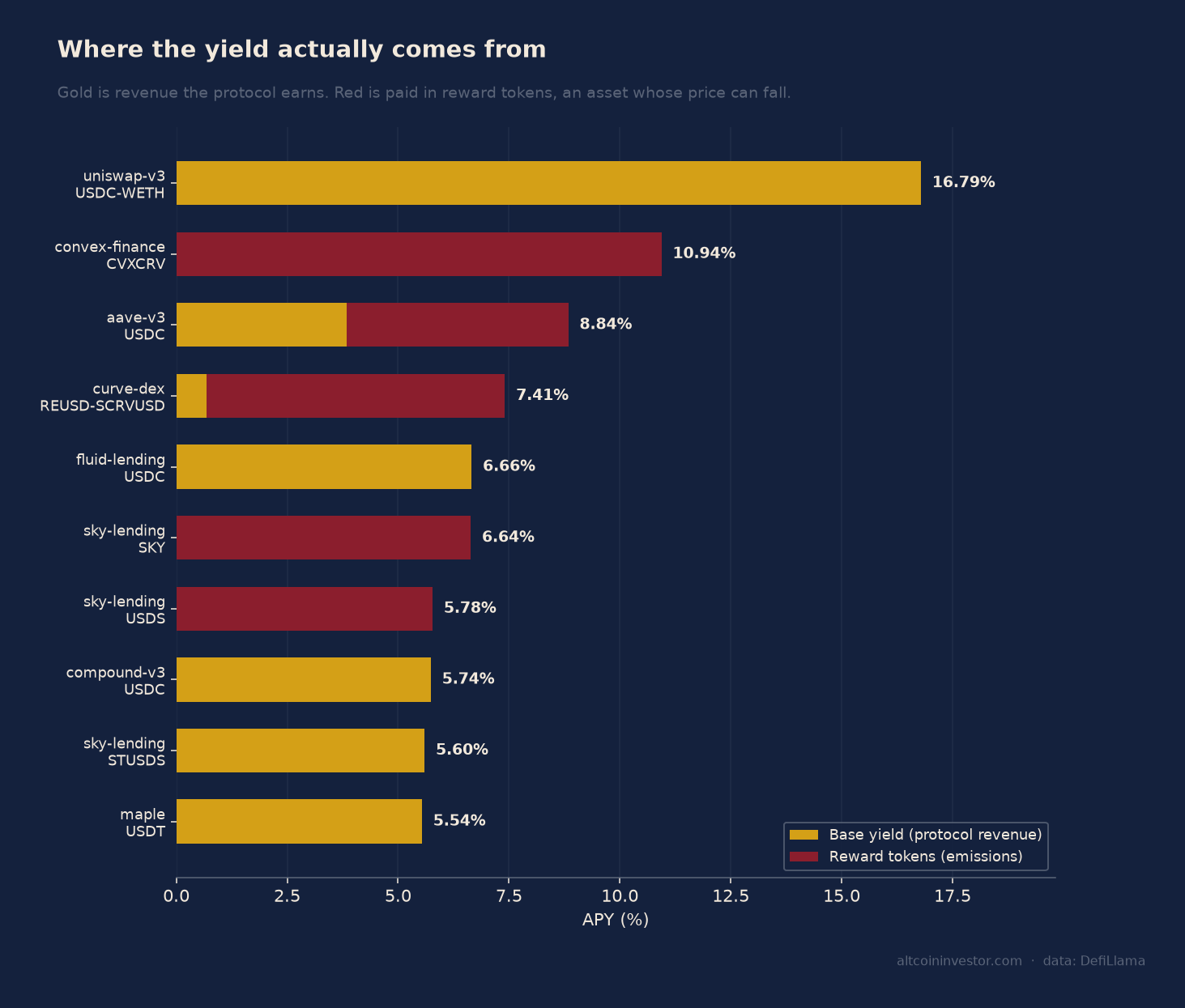
Comparing against the 8 October 2026 dataset, six new venues appeared. Sky introduced a SKY token pool at 6.64% (100% emissions) and the STUSDS pool at 5.6%. Aave v3 launched a WETH pool at 6.33% (79% of which is emissions). Curve added a CRVUSD-WBTC pool at 2.25%. Spark Savings opened an ETH pool at 1.4%. Aave v3 USDC on Base appeared at 8.84%, of which 57% is emissions.
Six venues dropped from the dataset, all of which no longer meet the minimum bars. Curve CRVUSD-CBBTC (was 1.21%), Uniswap v3 WBTC-USDT (was 25.54%), Aave v3 WETH (was 4.82%), Compound v3 USDT (was 3.23%), Fluid USDC (was 14.34%), and Curve CRV-CVXCRV (was 9.24%) all fell out.
The largest move was Uniswap v3 USDC-WETH, which climbed from 9.46% to 16.79%, a gain of 7.33 percentage points. Jupiter lend USDC rose from 4.15% to 6.18%. Convex cvxCRV increased from 9.16% to 10.94%. Curve rEUSD-scrvUSD fell from 8.75% to 7.41%. Compound v3 USDC dropped from 6.87% to 5.74%.
This is a quieter week in terms of net additions, but the removals signal continued volatility in emission-heavy LP pools.
Where The Yield Is Not Real
A pool paying 10% is not a 10% pool if 9% of that comes from a token down 60% year-to-date. As of 15 October 2026, the following venues derive most or all of their headline APY from reward token emissions.
Convex cvxCRV pays 10.94%, 100% of which is emissions. Aave v3 USDC on Base pays 8.84%, of which 57% (5 percentage points) is emissions. Curve rEUSD-scrvUSD pays 7.41%, of which 91% is emissions. Sky SKY pays 6.64%, all emissions. Aave v3 WETH on Base and Ethereum pays 6.33%, of which 79% is emissions. Sky USDS on Ethereum pays 5.78%, all emissions.
Aave v3 RLUSD on Ethereum pays 4.98%, of which 65% is emissions. Usual BUSD0 pays 4.72%, all emissions, though the base layer is treasury-backed. Sparklend USDS on Ethereum pays 4.0%, all emissions.
The base yields in these pools range from 0% to 3.84%. The reward tokens fluctuate. A 10% headline becomes a 1% reality if the token halves before you exit. This is not yield. It is speculative token exposure dressed as income.
How To Verify Any Of This
Every figure in this report is taken from DefiLlama as of 15 October 2026. Yields change daily, so these are snapshots, not promises. Each pool in the dataset carries a verification URL.
To verify Sky SUSDS at 3.8%, follow the link. To check Aave v3 USDT at 3.31%, follow the link. To confirm Sky STUSDS at 5.6%, follow the link. To validate Ethena sUSDe at 4.91%, follow the link. To review Ondo USDY at 3.68%, follow the link. To inspect Lido stETH at 2.25%, follow the link. To examine Jupiter jupSOL at 5.45%, follow the link.
The point is not to trust this report. The point is that you can check it in one click.