

 By
By How Crypto Cards Turn Stablecoins Into Everyday Payments for AI, Ads and Travel
Crypto has become much easier to buy, hold and transfer. Spending it is still surprisingly awkward.
A freelancer can receive a $2,000 payment in USDT in a few minutes. A trader can move funds between wallets at midnight. A remote team can settle an invoice without waiting for an international wire. Then someone tries to use that same money to pay for an AI subscription, buy a plane ticket or fund an advertising account, and suddenly they are back in the traditional banking system.
Most businesses still want a card number.
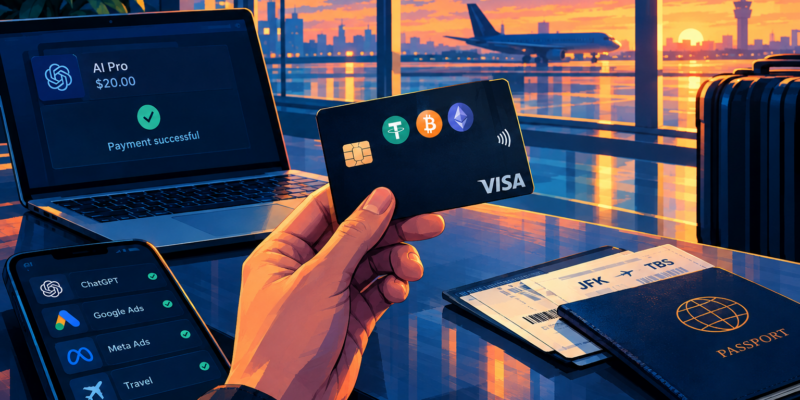
That gap has created a practical role for crypto cards. They connect digital assets with payment infrastructure that already exists, allowing people to use crypto without waiting for every merchant on the internet to add a “Pay with USDT” button.
Services such as IZIPAY are built around that idea: fund a card from crypto, then use the card for ordinary online and mobile payments where it is accepted.
For many crypto users, that is more useful than another place to trade tokens.
The problem is no longer getting crypto
A few years ago, getting hold of cryptocurrency was the difficult part. Exchanges were less mature, fiat on-ramps were clumsy, and transferring assets between platforms could feel intimidating.
Today, the bigger problem for some users is going in the opposite direction.
Imagine a freelance developer who gets paid in USDT. His monthly expenses include an AI coding assistant, hosting, a VPN, cloud storage and perhaps a few hundred dollars of advertising for a side project.
None of those companies needs to know that his income arrived on-chain. They simply expect a conventional payment method.
The usual route looks something like this:
Crypto wallet → exchange → sell crypto → bank withdrawal → bank card → merchant.
It works, but it adds several steps to what should be a simple purchase.
A crypto-funded card reduces that chain. The user moves part of a crypto balance onto the card and pays through the same checkout infrastructure that millions of merchants already use.
That is a much less ambitious idea than replacing Visa, Mastercard or the banking system. It is also much more immediately useful.
Why stablecoins make crypto cards more practical
Bitcoin is excellent at being Bitcoin. It is less convenient as a budgeting unit for a $20 software subscription.
Stablecoins changed the economics of crypto spending because they gave users a way to hold money on-chain without accepting the same day-to-day volatility as BTC or ETH.
If someone receives $3,000 in USDT and wants to allocate $500 to business expenses, the calculation is straightforward. There is no need to wonder whether tomorrow’s advertising budget will be 6% smaller because the market moved overnight.
This is why stablecoins and crypto cards fit together so naturally.
The stablecoin is the balance. The card is the interface with the existing economy.
A user can keep long-term investments separate, move a defined amount into a spending balance, and use that amount for normal purchases.
AI subscriptions are a perfect example
AI is one of the clearest use cases.
Developers, students, marketers and small businesses now routinely pay for products such as ChatGPT, Claude, Gemini, Cursor, Midjourney and other AI services.
Most of these products use ordinary subscription billing. Even companies building some of the world’s most advanced software generally expect customers to pay through familiar payment rails.
For somebody already paid in crypto, repeatedly converting small amounts through an exchange is unnecessary friction.
A virtual crypto card can instead become a dedicated card for digital subscriptions.
There is another benefit here: separation.
Putting every SaaS subscription on a personal bank card makes it harder to see how much is being spent on software. A separate crypto-funded card can give a freelancer or small team a cleaner view of these expenses.
The same idea works for hosting, domains, design software, analytics tools and API services.
Advertising is another natural use case
Online advertising consumes enormous amounts of working capital, and the businesses buying ads are increasingly international.
An affiliate marketer might earn revenue in USDT while buying traffic from Google, Meta, TikTok, Taboola or another platform. A Web3 startup may hold part of its treasury in stablecoins while paying thousands of dollars a month for user acquisition.
There is an obvious mismatch when revenue arrives in crypto but every advertising invoice has to travel through an exchange and a bank before it can be spent again.
For these businesses, a card can become part of the operating loop:
Crypto revenue → card balance → advertising spend.
There are practical benefits beyond speed. A marketing team can keep advertising money separate from other company spending. Agencies can use different cards for different clients or campaigns. If a campaign is paused, its spending balance can remain isolated instead of sharing a card with everything else the company pays for.
This is less glamorous than most crypto narratives. It is also the sort of problem businesses actually pay to solve.
Mobile wallets make the card useful away from a laptop
The usefulness of a crypto card changes considerably once it can be added to Apple Pay or Google Pay.
Without a mobile wallet, a virtual card is mostly an online tool. You copy the card number into a checkout form and make a purchase.
With a compatible mobile wallet, the same card can become useful at physical merchants that support contactless payments.
A traveler who holds stablecoins might use the card to book a hotel online, then use a phone to pay for lunch after arriving. There is no need to find a restaurant that accepts USDT directly.
This distinction matters because direct cryptocurrency acceptance remains fragmented. Even enthusiastic crypto users generally do not want to inspect a merchant’s blockchain support before buying coffee.
Card infrastructure handles that interoperability.
Of course, mobile-wallet availability depends on the card, country, device and merchant. A crypto card should not be treated as a guarantee that every terminal in every country will accept it. But where compatible card and mobile-wallet payments are supported, the experience is much closer to using a conventional card.
Travel exposes the weakness of wallet-only crypto
Travel is where the difference between owning crypto and being able to spend it becomes obvious.
A digital nomad may have plenty of money in a wallet and still run into problems paying for:
- a hotel deposit;
- an airline ticket;
- a rideshare;
- a train booking;
- a restaurant;
- a last-minute software subscription while abroad.
Direct crypto acceptance varies wildly between these services.
Card acceptance is much more predictable.
This is why crypto cards have become particularly relevant for people whose financial lives are international. Their income may arrive from one country, their crypto may sit in a self-custody wallet, and the merchant they need to pay may be based somewhere else entirely.
A card gives those separate systems a common language.
One card can cover a surprisingly large part of the internet
Once users understand the model, the number of possible use cases becomes fairly broad.
A crypto-funded card can potentially be used for AI tools, online advertising, streaming subscriptions, games, software, e-commerce and travel wherever the relevant card payment is supported.
IZIPAY maintains a directory of merchants and services commonly paid for with its cards, which gives a useful sense of how wide this category has become. The list ranges from AI and advertising platforms to travel, gaming, software and online shopping.
That does not mean every payment will always succeed. Merchants have their own rules. Some restrict virtual or prepaid cards. Others apply regional billing requirements or ask for additional verification.
That is normal card-payment behavior, not something unique to crypto cards.
The useful shift is that the merchant no longer needs to support cryptocurrency itself.
Crypto cards also have limits
It is worth being realistic about what these products do.
A crypto card does not make tax obligations disappear. Converting or spending digital assets may create reportable or taxable events depending on the user’s country.
It does not override a merchant’s terms.
It does not turn a region-restricted product into a globally available one.
And it does not mean users can ignore billing information, account country or fraud checks. Online payment systems increasingly compare details such as billing addresses, card origin, account history, device information and IP location.
Users who treat a virtual card like a disposable anonymous number and enter random information at checkout are more likely to have payments declined.
The technology works best when it is used as a normal payment method.
The bigger shift is from crypto investing to crypto utility
For years, most consumer crypto products were built around one question: what can you buy?
That encouraged speculation first and utility second.
Crypto cards start from a different question: what can you do with the assets you already own?
For someone who is paid in stablecoins, the answer may be fairly mundane. Buy software. Pay an ad bill. Renew an AI subscription. Book a flight. Pay for dinner.
That mundanity is important.
Technologies become useful when people stop thinking about the technology during routine tasks. Nobody thinks about card-network infrastructure while buying groceries. Nobody studies international settlement before subscribing to a streaming service.
Crypto spending will probably move in the same direction.
The merchant does not need to become a crypto company. The customer does not need a special blockchain checkout. The conversion happens in the payment layer between them.
For crypto holders who already live partly on-chain, that may be the most practical version of adoption we have seen so far.
Crypto cards do not replace wallets, exchanges or banks. They solve a narrower problem: turning digital assets into something that can be used in the payment systems people encounter every day.
And sometimes a narrow solution is exactly what a market needs.