

 By
By Can ADA break $0.19 after hard fork?
Cardano price remained under pressure on Monday despite the activation of the network’s van Rossem hard fork, leaving ADA traders focused on whether the token can break through its next major resistance zone.
Summary
- Cardano remains near $0.16 as weak momentum limits gains following the van Rossem hard fork.
- ADA must reclaim $0.17 and $0.19 before the broader downtrend shows clearer signs of reversing.
- Positive funding offers support, but a sub-one long-short ratio shows traders remain cautious about recovery.
ADA was trading near $0.162 at the time of writing, down around 2% over 24 hours. The token has remained broadly flat over the past month after a long decline from levels near $0.90 to $1.00. Its market capitalization stands near $6.06 billion, while daily trading volume is around $240 million.
The latest price action comes just after Cardano moved to Protocol Version 11 through the van Rossem hard fork. The network upgrade improved parts of the Plutus smart contract framework and prepared Cardano for future scaling work, but it has not yet produced a sustained ADA price rally.
Cardano price struggles to hold above $0.16
The ADA/USDT daily chart remains in a broader bearish structure. Cardano has fallen sharply from its 2025 highs and recently settled into a narrow range around $0.16. The latest consolidation has slowed the decline, but buyers have yet to establish a clear sequence of higher highs and higher lows.
ADA is also trading below the middle Bollinger Band near $0.1688. The upper band sits around $0.1887, while the lower band is close to $0.1489. This places the price in the lower half of its current volatility range. A sustained move above $0.17 would improve the short-term setup, while a renewed decline could put the $0.15 area back in focus.
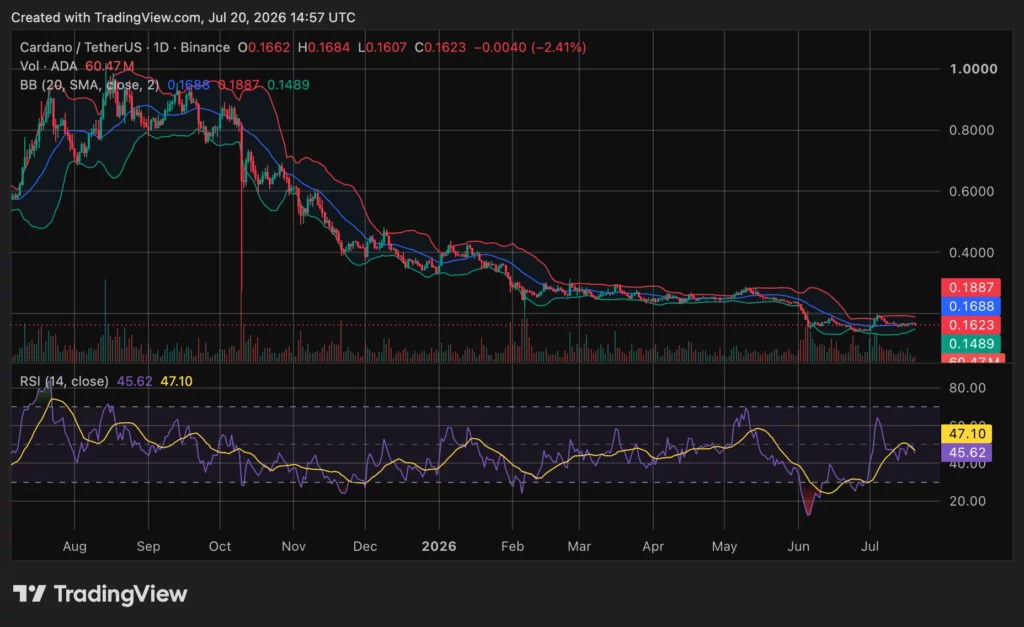
The Relative Strength Index stands at 45.62, slightly below its moving average of 47.10. The reading shows that momentum has recovered from more extreme selling conditions but remains below the neutral 50 mark. Buyers therefore have not yet gained firm control of the daily trend.
This weak structure follows months of pressure on ADA. Cardano fell below $0.20 in June as its broader market decline continued. Earlier technical analysis also identified weak momentum indicators as ADA struggled to establish durable support.
Van Rossem hard fork fails to trigger an immediate ADA rally
Cardano activated the van Rossem hard fork on July 18, taking the mainnet to Protocol Version 11. The upgrade became the network’s first hard fork approved and ratified entirely through its onchain governance system.
The upgrade adds Plutus improvements and changes to the cost model used for smart contract execution. It also prepares the technical foundation for the planned Dijkstra era and Ouroboros Leios, which aims to increase Cardano’s transaction capacity. As crypto.news reported, the upgrade went live after moving through Cardano’s governance process and earlier testnet stages.
However, ADA has so far shown little sustained response to the network event. The token remains near the same price area it occupied before activation. That price behavior suggests traders are still weighing broader market conditions and technical resistance alongside the protocol upgrade.
The hard fork can improve the network’s underlying technology without automatically driving immediate demand for ADA. For the price setup, traders are now watching whether activity following the upgrade can support stronger buying pressure over a longer period.
Mixed derivatives data keeps traders cautious
Derivatives indicators also show a divided market. ADA funding rates recently turned positive, with the rate at about 0.0061%. Positive funding generally means traders holding long positions pay those holding shorts, showing that positioning has shifted somewhat toward the bullish side.
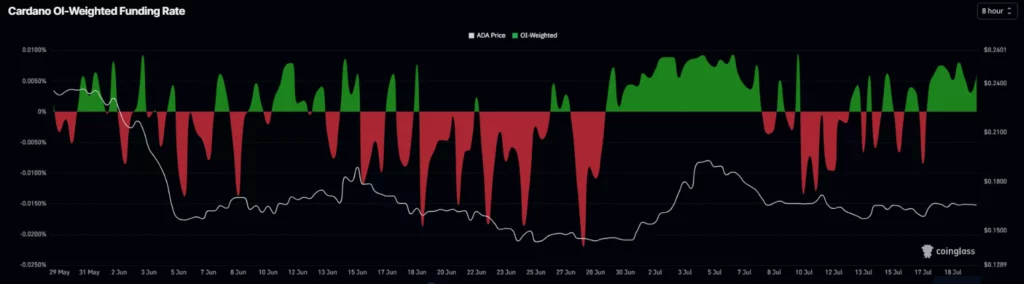
However, the ADA long-to-short ratio remained near 0.90. A reading below one means short positions continue to outnumber longs under that measure. The two indicators therefore point in different directions, with improving funding but continued caution among derivatives traders.
The mixed positioning follows heavy short interest ahead of the hard fork. ADA traded near $0.1628 before the upgrade as traders increased bearish positions even while large holders accumulated tokens. Liquidity was concentrated around $0.16 and $0.17, making those levels important for the next move.
The $0.16 area has continued to act as an immediate support zone after the fork. Losing that level could expose ADA to the lower Bollinger Band near $0.149. Holding it would give buyers another opportunity to test the resistance immediately above the current range.
ADA needs to reclaim $0.17 to target $0.19
The first technical level for Cardano bulls is the $0.168 to $0.17 area, which aligns closely with the middle Bollinger Band and a previous liquidity zone. A daily move above that range would return ADA to the upper half of its recent trading channel.
Beyond that, the $0.188 to $0.19 area represents the next major resistance zone. The upper Bollinger Band sits near this level, making a break above $0.19 a stronger signal that the short-term structure is changing. RSI would also need to climb above 50 to show firmer momentum from buyers.
Until those conditions develop, ADA remains in a consolidation phase inside a much larger downtrend. The van Rossem upgrade provides a new network catalyst, while development toward Leios gives Cardano another technical milestone to watch. However, price confirmation still depends on buyers pushing through nearby resistance.