


 By
By Bitcoin price slides to $85K: How low can BTC go in December?
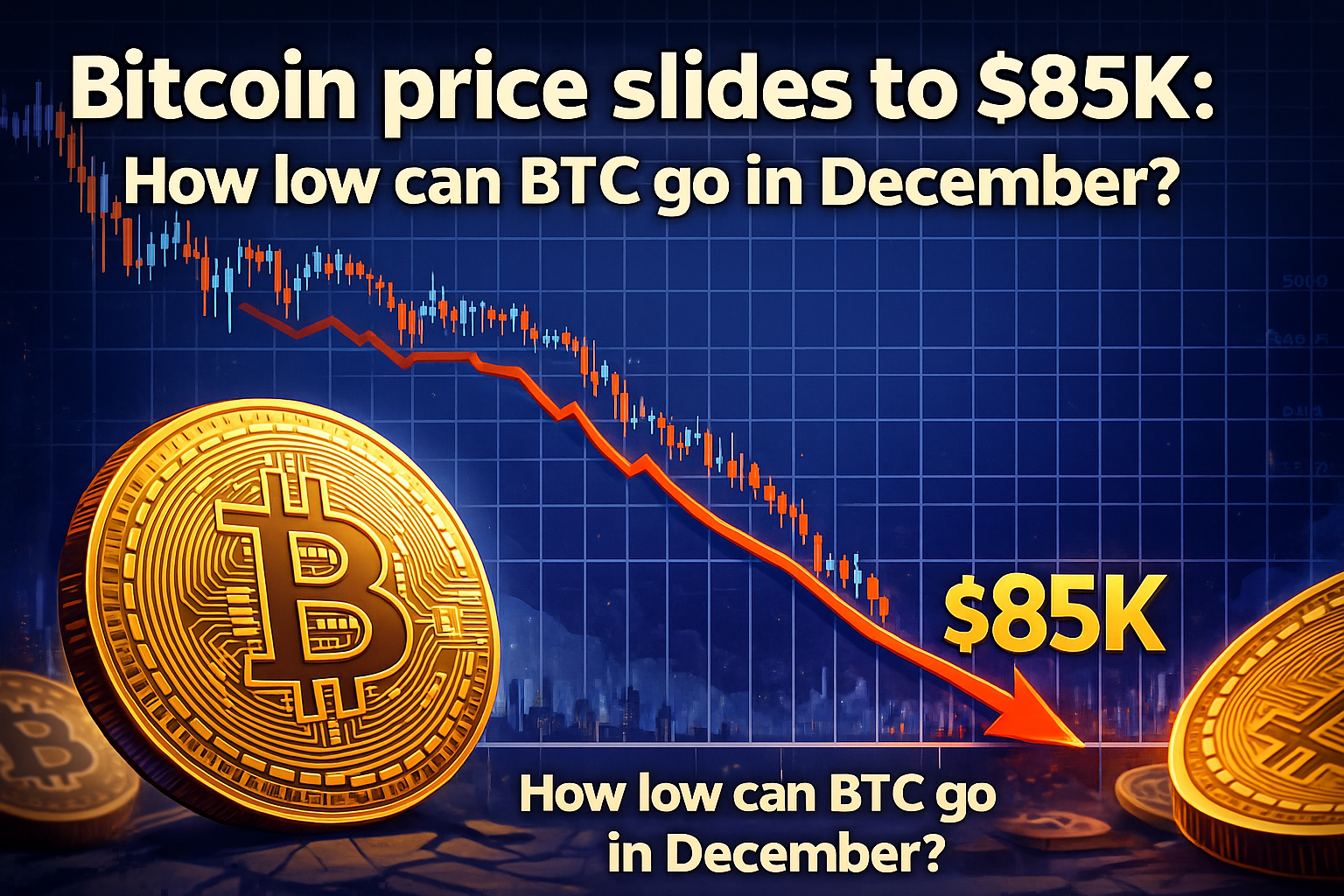
Bitcoin’s retracement to the $85,000 level isn’t a sign of collapse — it’s a calculated breather, a strategic pause that seasoned crypto investors understand as part of a well-worn pattern of cyclical growth.
In the wake of a sharp surge that pushed Bitcoin beyond the $90K milestone, the return to $85K has reignited fears reminiscent of past corrections. Headlines screaming of an impending crash or another crypto winter have surfaced, stirring unease among retail traders. But if we dig deeper, the reality diverges sharply from the panic narrative. Both on-chain data and key macroeconomic indicators suggest this phase is not a prelude to a crash — rather, it’s an opportunity for strategic accumulation. This isn’t Bitcoin’s end. It's another pivotal checkpoint on its journey toward even higher valuations.
Corrections: The Pulse of a Healthy Bull Market
Corrections are often misunderstood in the context of bull markets. While price pullbacks can rattle the nerves, they are an essential feature of sustained uptrends. A bull market isn’t a straight line up; rather, it includes periodic dips that allow the asset to regain momentum and consolidate gains. Looking at Bitcoin’s price action from a broader lens, we see a different narrative emerge — one of impressive year-over-year growth. As of mid-2024, Bitcoin is up more than 40% YTD, remaining well within bullish territory.
Historically, Bitcoin bull markets have been punctuated by 10–20% retracements before continuing their upward trajectory. In 2013, the leading cryptocurrency saw multiple pullbacks of 15–25% before ultimately breaking above $1,000 for the first time. During 2017’s explosive rally, BTC fell from $7,800 to $5,500 in November — a near 30% correction — only to rally to $20,000 within weeks. Similarly, in 2021, the digital asset declined from $42,000 to $28,000, shaking out weak hands, before climbing to what was then an all-time high of $69,000.
The current retreat to $85K follows this pattern. It doesn’t indicate a fundamental weakness, but rather signals the normal ebb and flow of a dynamic market. Short-term volatility is the price of long-term gains in the crypto space.
Support Zones Below $85K Offer Strategic Entry Points
If Bitcoin dips further below $85,000, key technical and psychological support levels come into play. Zones at $80K and $76.5K are especially noteworthy, with strong historical liquidity and significant bid walls already forming on major exchanges. These areas have shown buyer strength in previous cycles and are likely to act as critical accumulation zones once again.
Institutional interest has not waned. Instead, it has become more agile and calculated. According to recent reports from leading analytics platforms, large-scale wallets — or “whales” — have consistently added to their holdings during every meaningful dip in 2024. The rise in over-the-counter (OTC) desk activity also suggests that institutional entities are accumulating off-exchange, reinforcing a strategy aimed at long-term positioning rather than short-term speculation.
In addition, data signals an ongoing shuffle in ownership from short-term traders to long-term holders — what is often referred to as “strong hands.” This kind of shift historically precedes the next leg up in a bull run as it reflects conviction over fear.
On-Chain Metrics Highlight Underlying Market Resilience
When it comes to understanding Bitcoin’s real-time health, on-chain metrics act like vital signs. These indicators — from hash rate stability to HODL ratios — paint a picture that is far more bullish than the day-to-day price action suggests.
One of the most compelling metrics is the sustained increase in wallet addresses holding BTC for over a year. Long-term holding behavior is peaking, with over 70% of the total supply sitting dormant for more than 365 days, indicating strong belief in Bitcoin’s future appreciation. These holders are typically less reactive to volatility and provide a steadying effect on price.
Exchange outflows present another optimistic data point. Net BTC outflows from major centralized exchanges have grown noticeably in recent weeks, signaling a preference for self-custody and long-term storage over trading or liquidation. This trend runs counter to bearish narratives, as it shows fewer coins are available for selling pressure at the market level.
Furthermore, the Bitcoin network’s hash rate continues reaching new all-time highs. Increased computational power signals greater security and miner confidence. Typically, miners are among the most informed participants in the ecosystem, and their investment in infrastructure is a strong vote of confidence for Bitcoin’s prospects through 2024 and beyond.
Macro Tailwinds Are Strengthening the Bull Case
Bitcoin doesn't exist in a vacuum. The global macroeconomic landscape plays a significant role in shaping investor sentiment and capital flow — and right now, those winds appear to be blowing in Bitcoin’s favor.
The Federal Reserve's projected shift toward more accommodative monetary policy, potentially cutting interest rates in the second half of 2024, is extremely bullish for risk assets. As real yields decline, the opportunity cost of holding non-yielding assets like Bitcoin diminishes. Investors seek stores of value that can outperform inflation and currency debasement. In this context, Bitcoin’s fixed supply and decentralized nature stand out.
Additionally, the U.S. dollar index (DXY) has begun showing signs of weakness, which often correlates with rising Bitcoin prices. A softening dollar makes crypto assets — priced primarily in dollars — more attractive on the global stage. Add to this the increasing fragility in traditional banking systems, as evidenced by ongoing liquidity crises in various regions, and Bitcoin’s role as a decentralized hedge becomes clearer.
Geopolitical upheaval and ongoing tension in major economic zones have also amplified Bitcoin’s appeal as a neutral, censorship-resistant asset. During times of uncertainty, liquidity often flees from centralized systems and into assets with lower systemic risk — of which Bitcoin is one of the foremost examples.
Smart Investors View Dips as Opportunity
For those paying attention, this current correction represents a potential golden entry point rather than a warning signal. Rather than reacting emotionally, seasoned market participants recognize this moment as a repeat of historical buying zones that preceded major rallies.
Dollar-cost averaging (DCA) during retracements remains a proven strategy in crypto investing. By entering positions incrementally during market dips, investors can reduce entry risk and benefit from long-term upside. This approach removes the emotional burden of trying to “buy the bottom” and instead focuses on consistent exposure to an appreciating asset.
Particularly in this segment of the bull cycle, asymmetric risk/reward opportunities are rare in traditional markets, but still alive and well in crypto. Even if Bitcoin does move slightly lower in the short term, the broader trajectory remains upward — driven by network demand, institutional adoption, and macroeconomic catalysts.
An added layer to this uptrend is the approaching Bitcoin halving event, expected in the first half of 2024. Historically, halving cycles have resulted in supply shocks that drive prices significantly higher within 12 to 18 months. With this tailwind ahead, accumulating at or near $85K could represent the final opportunity for gains before the next exponential move upward.
Conclusion: Reframing the $85K Dip
The recent dip to $85,000 should not provoke fear but rather inspire strategic thinking. For the informed investor, this correction is not a setback — it’s a confirmation. A confirmation that the market is working through normal phases of expansion, preparing for future highs. The combination of strong on-chain metrics, macro tailwinds, and institutional conviction suggests that Bitcoin remains in a robust market structure.
Bottom line: Bitcoin’s pullback is far from a breakdown. For those who can see beyond the noise and headlines, this moment may emerge as one of the most attractive entry points of the 2024 bull cycle. Stay informed, stay patient, and remember — the long game rewards those who don’t flinch in the face of volatility.